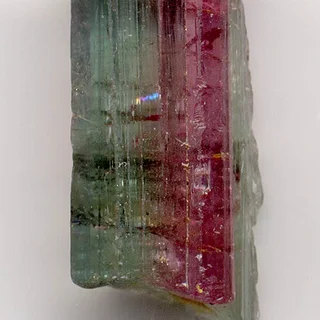

Tourmaline Meaning, Lore, and Benefits
A comprehensive guide to Tourmaline, the October birthstone, covering the origins of its meanings 'Patience, Hope, and Generosity', its mineral properties as an 'electric stone', the significance of its various colors like black, pink, and watermelon, its attributed benefits, compatible stones, care instructions, and FAQs.
Table of Contents (Tap to toggle)
Introduction
Known as the "Gemstone of 100 Colors," Tourmaline is a rare mineral group that encompasses almost every color variation—pink, green, blue, black, watermelon, and more. As an additional October birthstone, and true to its alternate name, "Electric Stone," it has long been cherished as a stone of protection and purification due to its unique physical property of becoming electrically charged through friction.
This article provides a comprehensive overview, from the origins of its gemstone lore and mineralogical characteristics to the meanings and uses of different color varieties, its attributed benefits, care methods, how to distinguish natural, synthetic, and treated stones, and frequently asked questions. We've structured this as a definitive guide to Tourmaline, a go-to resource for understanding individual color varieties like black, pink, and watermelon.
Table of Contents
- Basic Information and Mineral Data
- Characteristics and Meanings by Color Variety
- Stone Lore and Historical and Cultural Background
- Attributed Benefits and Effects
- How to Use for Protection and Purification
- Complementary Combinations
- Purification Methods and Care
- Distinguishing Natural, Synthetic, and Treated Stones
- Frequently Asked Questions (FAQ)
- Editor's Notes
- Editorial Team's Perspective
- Related Articles
Basic Information and Mineral Data
| Item | Content |
|---|---|
| Stone Name | Tourmaline |
| Japanese Name | Denki-seki (Electric Stone) |
| Mineral Species | Tourmaline Group (Complex Silicate) |
| Crystal System | Trigonal |
| Main Sources | Brazil, Sri Lanka, Madagascar, Myanmar, Afghanistan, USA |
| Mohs Hardness | 7 to 7.5 |
| Specific Gravity | 3.06 to 3.25 |
| Refractive Index | 1.624 to 1.644 |
| Colors | Almost all colors (colorless, pink, red, green, blue, black, bi-color, etc.) |
Tourmaline is a group name encompassing over 11 mineral species with differing chemical compositions. While sharing a common crystal structure, trace elements cause variations in color. For example, high iron content leads to black (Schorl), lithium to diverse colors (Elbaite), and magnesium to brown (Dravite) — the color is determined by the locality and composition.
The most prominent features of Tourmaline are "pyroelectricity" and "piezoelectricity" — physical phenomena where it becomes electrically charged when heated or subjected to pressure/friction. Historically known as "the stone that gathers ash," the observation that heated tourmaline attracted tobacco ash led to its Japanese name, "Denki-seki (Electric Stone)."
With a Mohs hardness of 7 to 7.5, it is sufficiently durable for daily use. However, it is vulnerable to sudden temperature changes, so caution is advised when handling it in baths or kitchens.
Characteristics and Meanings by Color Variety
Tourmaline's name, meaning, and popularity vary significantly by color. The main color varieties are as follows:
| Color Variety | Common Name | Primary Meaning and Benefit |
|---|---|---|
| Black Tourmaline | Schorl | Classic for protection and EMF shielding. The variety with the highest iron content |
| Pink Tourmaline | Rubellite (deep red) / General Pink | Love luck and self-affirmation. Corresponds to the heart chakra |
| Green Tourmaline | Verdelite | Financial luck and healing. Symbolizes purification of mind and body, and health |
| Blue Tourmaline | Indicolite | Communication and intuition. One of the rarest colors |
| Watermelon Tourmaline | (Bi-color) | A rare bi-color variety with green and pink coexisting. Harmony of love and healing |
| Paraíba Tourmaline | (Neon Blue) | A rare stone discovered in the late 20th century. The pinnacle of investment-grade gems |
| Dravite | (Brown to Yellow-Brown) | Grounding and practical problem-solving ability |
Even though it's all "Tourmaline," each color variety is treated as a distinct gemstone due to their differing characteristics. This article covers the general meanings, but for choosing based on specific uses, starting with the "meaning by color variety" is the correct approach.
Stone Lore and Historical and Cultural Background
The general meanings associated with Tourmaline are "Patience, Hope, Generosity, and Friendship." Its etymology comes from the Sinhala word (Sri Lanka) "turamali = stone of mixed colors," which became established when Dutch merchants brought it back from Sri Lanka in the 18th century.
In ancient Egypt, a myth tells of Tourmaline being "a stone that traveled from the center of the Earth across a rainbow to reach the surface," and its diverse colors were believed to be "fragments of the rainbow." In 1703, Dutch merchants noticed the strange electrification of heated Tourmaline, which they called "the stone that gathers ash," sparking significant interest in the European scientific community. This led to its Japanese name "Electric Stone" and became the origin of the modern legend of "a stone that generates negative ions."
Empress Dowager Cixi of China's Qing Dynasty was known to have extensively collected pink Tourmaline (especially from California), considering it "the stone she loved most among all her jewelry." It is said that tens of kilograms of pink Tourmaline were buried with her in her tomb.
In the late 20th century (1989), "neon blue glowing Tourmaline" was discovered in Paraíba, Brazil, and Paraíba Tourmaline quickly swept the global gem market. Today, it stands as one of the most prized gemstones, with prices reaching several million yen per carat.
Source: GIA (Gemological Institute of America) Tourmaline Overview, AGTA (American Gem Trade Association) Gemological Material, etc.
Recommended for these people:
- Those who want to choose a stone that suits them from a variety of colors.
- Those looking for an amulet for protection and electromagnetic radiation shielding (→ Black Tourmaline).
- Those looking for a gift for themselves, family, or partners born in October.
- Those interested in rare, investment-grade gemstones (→ Paraíba Tourmaline).
Attributed Benefits and Effects
Note: The "effects" of crystals are cultural and symbolic in nature. They are not medically or scientifically guaranteed, and individual experiences may vary.
- Symbol of Protection and Ward Against Evil — Especially Black Tourmaline, cherished since ancient times as "the strongest protective stone."
- Amulet for Electromagnetic Radiation Shielding — Due to its electrically charged physical properties, it is worn as an amulet in modern PC and smartphone environments.
- Support for Diverse Fortunes — The only gemstone that can be chosen for specific purposes such as love, financial luck, health, or intuition, depending on its color variety.
- Negative Ion Legend — A cultural background where it became widely distributed as a health product after the 1990s.
- Fostering Friendship and Generosity — Believed to support harmony in human relationships, symbolizing "mixed colors = embracing diversity."
Regardless of whether one believes in the "effects" as a legend, the flexibility to choose a color that aligns with one's own purpose is Tourmaline's greatest charm. As a rare gem that can "cover all desires within a single mineral group," it is beloved by collectors and beginners alike.
Note: While the "negative ion generation" of Tourmaline was widely promoted in health product advertisements, its health benefits when worn have not been scientifically proven. Enjoying its symbolic significance as an amulet is the intended way to interact with it.
How to Use Tourmaline for Protection and Purification
- Place Black Tourmaline at the entrance and around your PC A classic placement for protection and electromagnetic radiation shielding. Traditionally, raw stones or tumbled stones are placed on shoe racks at the entrance or next to a PC on a desk.
- Wear Pink Tourmaline as a pendant near your chest Believed to harmonize with the heart chakra, symbolizing self-affirmation and love luck. A single pink Tourmaline necklace is perfect for everyday wear.
- Wear Green Tourmaline as a bracelet on your left wrist The left side corresponds to "receiving" energy. Ideal for periods when you want to attract financial and health luck.
- Use Watermelon Tourmaline as commemorative jewelry A rare bi-color variety with green and pink coexisting. Excellent for milestone jewelry, such as wedding anniversaries or birthdays.
- A collection to use different colors as desired A popular way to enjoy Tourmaline is to "choose colors based on purpose and mood." Many enthusiasts use black for work, pink for holidays, and green for travel, for example.
Complementary Combinations
| Combination | Expected Meaning |
|---|---|
| Black Tourmaline and Quartz (Crystal) | The ultimate duo for protection and purification |
| Pink Tourmaline and Rose Quartz | Double support for love luck |
| Green Tourmaline and Aventurine | Harmonizing similar green hues for healing and financial luck |
| Tourmaline and Opal | Fellow October birthstones. A special combination of rainbow colors and multi-hues |
| Black Tourmaline and Morion | A top-tier pair for protection |
It is said that increasing the number of combinations too much can dilute the energy of each stone. Since Tourmaline has different characteristics depending on its color variety, choosing "one color for your current purpose" is a lasting approach.
Purification Methods and Care
Tourmaline has a Mohs hardness of 7 to 7.5, making it quite durable and compatible with most purification methods.
- Place on a Quartz cluster or small chips: A classic overnight purification method.
- Pass through White Sage smoke: 1 to 2 minutes is sufficient.
- Moonlight bathing: Place by a window for three days before and after the full moon.
- Running water: Briefly rinse with lukewarm water if desired.
- Sound bath with a tuning fork or crystal tuner: Effective if careful not to touch metal.
Purification methods to avoid:
- Burying in coarse salt for extended periods (may damage the surface).
- Prolonged use of an ultrasonic cleaner (may enlarge cracks in varieties with many inclusions).
- Sudden temperature changes (its pyroelectric nature can cause thermal shock and cracking).
- Prolonged exposure to direct sunlight (some color varieties, especially pink tourmaline, may fade).
For daily care, gently wipe with a soft cloth is fundamental. If sweat or sebum is a concern, quickly rinse with lukewarm water and dry immediately.
Distinguishing Natural, Synthetic, and Treated Stones
- Natural Tourmaline typically exhibits pleochroism (color changes depending on the viewing angle). Inclusions (thread-like internal features) are also natural.
- Synthetic Tourmaline is very rare in circulation, and the jewelry market primarily deals with natural specimens.
- Heat treatment is a standard process performed on some pink Tourmaline and Paraíba Tourmaline.
- Irradiation treatment enhances color. As it can reduce value, inquire when purchasing.
- Similar stones: Synthetic glass (watch out for multi-colored ones), dyed quartz, etc.
- Choosing one with a gemological certificate (e.g., GIA, CGL) is the most reliable method.
Especially for Paraíba Tourmaline, which is in the high price range (hundreds of thousands of yen per carat), the value varies depending on whether it is from Brazil, Mozambique, or Nigeria. Verification of origin with a gemological certificate is essential.
Frequently Asked Questions (FAQ)
Q1. How long can Tourmaline be worn?
A. With a Mohs hardness of 7 to 7.5, it is sufficiently durable for daily use and has the longevity to be passed down through generations. While the platinum and gold settings may wear down in 10 to 20 years, with regular re-setting or re-polishing of the metalwork, the stone itself can be enjoyed almost indefinitely.
Q2. Is it okay to wear it while bathing, swimming, or playing sports?
A. Short baths are generally okay, but sudden temperature changes (hot water to cold water) should be avoided due to its pyroelectric properties. Chlorine in pools and sulfur in hot springs can discolor the metal settings, and sports can cause impacts that may enlarge cracks. It is best to develop a habit of removing it to ensure its longevity.
Q3. Is the "negative ion effect" of Tourmaline real?
A. It has not been scientifically proven. This claim was widely promoted in health product advertisements after the 1990s, but no proven health benefits from wearing it have been confirmed. The name "Electric Stone" for Tourmaline derives from its physical property of becoming electrically charged through heating and friction, which is separate from any human health effects. Enjoying its symbolic significance as an amulet is the intended way to interact with it.
Q4. What is the difference between Black Tourmaline and Morion?
A. Although similar in appearance, they are different minerals. Black Tourmaline (Schorl) is a high-iron species within the Tourmaline group, while Morion (Black Quartz) is a black variety of Quartz. Both are "classic protective stones," but Black Tourmaline possesses properties as an electric stone, while Morion has versatility as Quartz.
Q5. Can I wear Tourmaline even if I'm not born in October?
A. Absolutely! Birthstones are merely "stones with particularly good compatibility," and there is no problem for those born in other months who wish to resonate with Tourmaline's lore of "Patience and Hope." Due to its diversity of color varieties, Tourmaline is cherished by a wide range of wearers, regardless of their birth month, as it allows them to "choose according to their current purpose."
Q6. What is Paraíba Tourmaline?
A. A rare color variety discovered in Paraíba, Brazil, in 1989, it glows with a neon blue to turquoise blue color due to the presence of copper and manganese. While subsequent discoveries were made in Mozambique and Nigeria, Brazilian Paraíba remains the most prized. It is an investment-grade gemstone, costing several million yen per carat, and holds a unique status within the entire Tourmaline family.
Editor's Notes
Tourmaline was the "first crystal" I ever encountered. When I was in middle school, I bought a raw Black Tourmaline stone (for 500 yen) at a local mineral show and placed it on my desk. My motivation was simple: I was drawn to the idea of "protection."
As an adult, I rediscovered the fact that Tourmaline has over 100 color variations. Black, pink, green, watermelon — it feels like having a different gemstone every time I switch colors, offering a refreshing experience.
I believe Tourmaline is a "stone you can explore and connect with different colors throughout your life." The perfect color for you today might be different from the one for your future self. Yet, within the larger "Tourmaline" family, you can journey through life's stages with different colors — that's the kind of profound and accommodating presence it holds.
Editorial Team's Perspective: "Choosing by Color Variety" is Key
A common pitfall in choosing Tourmaline is to speak of "Tourmaline" as a single entity. In reality, black, pink, and Paraíba should be treated as "distinctly different gemstones."
| Purpose | Recommended Color Variety |
|---|---|
| Protection and EMF Shielding | ◎ Black Tourmaline (Schorl) |
| Love Luck and Self-Affirmation | ◎ Pink Tourmaline (including Rubellite) |
| Financial Luck and Health | ◎ Green Tourmaline (Verdelite) |
| Communication and Intuition | ◎ Blue Tourmaline (Indicolite) |
| Commemorative Jewelry and Prioritizing Rarity | ◎ Watermelon or Paraíba |
| Grounding | ◎ Dravite (Brown to Yellow-Brown) |
In other words —
- Instead of "buying Tourmaline," decide on purchasing a specific type of Tourmaline.
- The essence is to choose a color variety that matches your purpose.
- Collecting multiple colors is also a fun way to enjoy it.
Common Misconceptions
- ❌ "Tourmaline = Negative Ion Health Stone" → ✅ Not scientifically proven. Its symbolic significance as an amulet is the essence.
- ❌ "Color does not affect value" → ✅ The value differs significantly, generally in the order of Paraíba > Rubellite > Verdelite > Indicolite > Pink > Green > Black.
- ❌ "Black Tourmaline = Morion" → ✅ They are different minerals. Black Tourmaline is an electric stone, Morion is Quartz.
A Word from Sun-chan☀️
Thank you for choosing Tourmaline, everyone🌈
This little one, you know, is a stone that will always help you find the perfect color for your current feelings! ✨ Among its family of over 100 colors, there's always one that's just right for you today!
Whether it's the protective black, the loving pink, or the healing green—no matter which you choose, the big "Tourmaline" family will always be by your side, so you can feel safe and happy!💛
Related Articles
- Black Tourmaline (Schorl) Meaning and Benefits — Sub-article: A classic for protection and EMF shielding
- October Birthstones | A Complete Guide to Opal, Tourmaline, and Rose Quartz — Comprehensive guide covering the three October stones
- 12-Month Birthstone Comprehensive Guide — Comparison and quick reference for all 12 months
- Opal Meaning and Benefits — A fellow October birthstone, a stone of hope with iridescent play-of-color
- Rose Quartz Meaning and Benefits — A classic for love luck, alongside Pink Tourmaline
- Morion (Black Quartz) Meaning and Benefits — A top-tier protective stone, alongside Black Tourmaline
- Protective Crystals — Compares Tourmaline's role in the protection section
- How to Properly Wear Crystals — Explains left/right hand usage and placement for maximizing effects
Summary
- Tourmaline is an additional October birthstone, symbolizing "Patience, Hope, and Generosity." It is a gemstone group with 100 colors.
- Key color varieties include Black (protection), Pink (love), Green (financial luck), Blue (intuition), Watermelon (bi-color), and Paraíba (rare).
- The name "Electric Stone" comes from its pyroelectric and piezoelectric properties. The negative ion effect is not scientifically proven.
- Compatible with most purification methods (only avoid prolonged coarse salt immersion and sudden temperature changes).
- As individual experiences of effects vary, it is best to approach it casually as an "amulet."
From the large family of "Tourmaline" with 100 colors, you can journey through life's stages with different colors — a profound and truly unique partner.
Tags
この記事をシェアする
この記事が役に立ったら、SNSでシェアしていただけるととても嬉しいです☀️

Thanks so much for reading! I hope this article brought a little sunshine to your day! See you again soon!
You might also like

October Birthstones
A comprehensive guide to October's birthstones: Opal, Tourmaline, and Rose Quartz. We cover their symbolic meanings like 'hope, innocence, and good fortune' inherent in their rainbow play-of-color, their role as symbols of art and creativity, how to wear and care for them, tips for choosing birthday gifts, fascinating trivia, and FAQs.
The Ultimate Crystal Guide by Purpose
Discover crystals traditionally associated with 10 key areas: love, wealth, career, health, relationships, marriage, studies, fertility, protection, and career changes, all in one comprehensive guide.
Apatite: Meaning, Stone Lore, and Effects
A comprehensive guide to Apatite: Its meaning, stone lore ('Communication, Academics, Goal Achievement'), effects, who it's recommended for, compatible stones, and purification methods. Discover the basics and practical uses of this 'Blue Guiding Stone' that helps you achieve your goals, all on one page.

How to Properly Wear Crystals
It's believed that the meaning of crystals changes depending on whether you wear them on your left or right hand. This beginner's guide provides a complete explanation of how to properly wear bracelets, pendants, rings, and earrings, how to align them with chakras, where to place them in your home, and even when not to wear them.