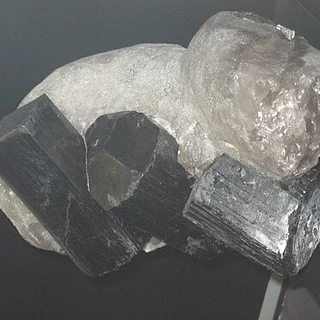

Black Tourmaline: Meaning, Stone Properties, and Effects
A comprehensive guide to Black Tourmaline (Schorl), the classic stone for protection and EMF shielding. Discover the origins of its properties like 'strong protection, purification, and grounding,' its place within the Tourmaline group, widely believed effects, compatible stones, care instructions, and FAQs.
Table of Contents (Tap to toggle)
Introduction
Often hailed as one of the "most powerful protective stones," Black Tourmaline is the common name for Schorl, the most iron-rich variety within the Tourmaline group. With its deep, jet-black luster and pyroelectric and piezoelectric properties (meaning it generates an electric charge when heated or rubbed), it has been cherished since ancient times as a stone that "wards off negative energies and offers protection."
In modern times, it continues to gain popularity as a crystal, serving as an amulet for EMF protection in our PC and smartphone-dominated world and a companion for desk workers needing to maintain focus. In this article, we've put together a comprehensive guide covering everything from the origins of its stone properties and mineralogical features to its distinction from Morion (Black Quartz), widely believed effects, care methods, and frequently asked questions.
Table of Contents
- Basic Information and Mineral Data
- Stone Properties and Historical and Cultural Background
- Widely Believed Effects
- How to Use for Protection and EMF Shielding
- Compatible Combinations
- Cleansing and Care Methods
- Identifying Natural and Similar Stones
- Frequently Asked Questions (FAQ)
- Editor's Note
- Our Editorial Team's View
- Related Articles You Might Also Like
Basic Information and Mineral Data
| Item | Details |
|---|---|
| Stone Name | Black Tourmaline / Schorl |
| Japanese Name | Tetsu-denkiseki (Iron Tourmaline) |
| Mineral Species | Tourmaline Group (Complex Silicate) |
| Crystal System | Trigonal |
| Primary Sources | Brazil, Pakistan, Africa, USA, Madagascar |
| Mohs Hardness | 7 to 7.5 |
| Specific Gravity | 3.10 to 3.25 |
| Refractive Index | 1.624 to 1.644 |
| Color | Jet Black to Brownish Black (colored by iron) |
Black Tourmaline is the most iron-rich variety within the Tourmaline group, with Schorl being its official mineralogical name. While it belongs to the same Tourmaline group as Pink Tourmaline and Green Tourmaline, its overwhelmingly high iron content gives it its deep, jet-black color.
A common characteristic of all tourmalines is their pyroelectricity and piezoelectricity—physical phenomena where they generate an electric charge when heated or rubbed. This property is the origin of its Japanese name "Denkiseki" (electric stone) and its traditional uses for "warding off negative energies and dealing with electromagnetic fields."
With a Mohs hardness of 7 to 7.5, it is sufficiently hard for daily use, and it has no cleavage, making it quite resistant to impact. It is widely available in various forms such as rough stones, tumbled stones, and bracelets. It is also popular as an entry-level gemstone, allowing you to start your authentic crystal journey at an accessible price range (from a few thousand yen).
Stone Properties and Historical and Cultural Background
Black Tourmaline's stone properties are "Strong Protection, Purification, Grounding, and Endurance."
The name "Tourmaline" itself comes from the Sinhala word (Sri Lanka) "turamalli, meaning 'stone of mixed colors'." Within this group, Schorl (black) derives its name from the German word "Schorl." Since ancient times, it has been known among European miners as a "stone that absorbs negative energies," and they had a custom of bringing it into the mine shafts.
In medieval Europe, alchemists kept Black Tourmaline in their laboratories as a "stone to protect against evil spirits." It was also believed that shamans and sorcerers wearing it during rituals could create a "barrier that blocks the entry of negative energies."
In 1703, a Dutch jeweler discovered the electrification phenomenon of heated tourmaline, calling it a "mysterious stone that attracts ashes," which caused a stir in the European scientific community. This became the origin of the Japanese name "Denkiseki" (electric stone) and modern legends such as "a stone that generates negative ions" and "a stone that absorbs electromagnetic waves."
Since the latter half of the 20th century, with the widespread adoption of PCs, televisions, and smartphones, the demand for Black Tourmaline as a "protective stone for EMF shielding" has surged. Today, it is one of the most widely circulated crystals, traditionally placed on desks, in bedrooms, and at entrances as a stone for warding off negative energies.
Sources: GIA (Gemological Institute of America) overview of Tourmaline, AGTA (American Gem Trade Association) mineralogical data, and more.
Recommended for these people
- Those seeking a powerful amulet for protection against evil and bad luck.
- Desk workers and creative professionals who spend long hours on PCs and smartphones.
- Individuals who are sensitive to stress in crowds or at work.
- Anyone feeling anxious or restless and wanting to feel more grounded.
Widely Believed Effects
Please Note: The "effects" of crystals are cultural and symbolic. These are not medically or scientifically guaranteed, and individual experiences may vary.
- Strong Protection and Warding off Negative Energies — Traditionally known as "one of the most powerful protective stones" since ancient times.
- Symbol of EMF Protection — Due to its pyroelectric and piezoelectric physical properties, it has become popular in modern times as an amulet for PC and smartphone environments.
- Grounding — Its deep, rich blackness is believed to support a state of mind where one feels "grounded" and "calm."
- Purification of Negative Energy — Symbolizes purifying inner anxiety, anger, and jealousy.
- Maintaining Focus — It is said to support concentration on work and study by blocking out surrounding noise.
Regardless of whether you believe in its traditional "effects," many users report that the mere fact of "a black stone being on their desk" visually serves as a mental switch, signaling "this is a place for focus from now on."
Important Note: While the "EMF protection effects" and "negative ion generation" of Black Tourmaline have been widely advertised in health product promotions, there is no scientific proof of any health benefits from wearing it. The true way to appreciate it is to enjoy its symbolic significance as an amulet.
How to Use for Protection and EMF Shielding
- Place it next to your desk or PC This is a classic placement for an amulet in PC and smartphone environments. Traditionally, rough or tumbled stones are placed next to the monitor or keyboard. It's perfect for enhancing both focus and protection.
- Place it at the entrance A traditional method to "block negative energies at the entrance of your home." It's commonly placed on top of a shoe cabinet or next to a shoe tray at the entrance.
- Place it by your bedside As an amulet to ward off nightmares and anxiety. Instead of placing it directly under your pillow, placing it on a side table or a shelf near the floor allows you to envision it forming a "protective barrier" around you while you sleep.
- Wear it as a bracelet on your left wrist The left side is traditionally believed to be associated with "receiving" energy. Wear it as a portable amulet in crowded places, workplaces, public transportation, or any environment where you might feel vulnerable to negative energies.
- Carry a tumbled stone in your pocket or bag For business trips, travel, or important meetings. A popular lightweight option is to carry a thumb-sized tumbled stone in your pocket or bag.
Compatible Combinations
| Combination | Expected Meaning |
|---|---|
| Black Tourmaline and Clear Quartz (Crystal) | Ultimate protection and purification: A classic combination. |
| Black Tourmaline and Morion (Black Quartz) | The ultimate protective pair. A double guard of black stones. |
| Black Tourmaline and Onyx | Enhanced protection and willpower. A triple black shield. |
| Black Tourmaline and Hematite | Double grounding enhancement. Promotes practical action. |
| Black Tourmaline and Amethyst | Wards off negative energy and heals. Balances work and rest. |
If you combine too many stones, it is said that the energies of individual stones can become dispersed. Since Black Tourmaline has a clear role as a "protective stone," a lasting approach is to use it simply, perhaps adding just one or two other stones.
Cleansing and Care Methods
Black Tourmaline has a Mohs hardness of 7 to 7.5, making it sufficiently hard and compatible with most cleansing methods.
- Place it on a Clear Quartz cluster or in smaller Clear Quartz chips: A classic overnight cleanse. The most highly recommended method.
- Pass it through white sage smoke: 1 to 2 minutes is sufficient. A traditional cleansing method fitting for a protective stone.
- Moonlight bath: Place it near a window during the three days before and after a full moon.
- Running water: A quick rinse under lukewarm running water is fine for short periods.
- Sound bath with a tuning fork or crystal tuner: Effective if you avoid touching it with metal.
Cleansing Methods to Avoid:
- Burying it in coarse salt for extended periods (as it may scratch the surface).
- Prolonged use of ultrasonic cleaners (as it could expand cracks in stones with many inclusions).
- Sudden temperature changes (due to its pyroelectric nature, thermal shock can cause it to crack).
Since Black Tourmaline is considered a "stone that absorbs negative energies," more frequent cleansing is recommended than for most other stones. There's a tradition that a weekly cleansing routine helps maintain its purity as an amulet.
Identifying Natural and Similar Stones
- Natural Black Tourmaline (Schorl) typically has a prismatic crystal structure and often shows vertical striations (grooves).
- Confusion with Morion (Black Quartz): Black Tourmaline is an electric stone (tourmaline), while Morion is a black variety of quartz (crystal) and a distinct mineral. They can be distinguished by their crystal structure and the direction of their striations.
- Confusion with Onyx (Black Onyx): This is a black variety of chalcedony and a distinct mineral. It can be distinguished by its translucency and luster.
- Confusion with black basalt and obsidian: Obsidian is vitreous (glassy) and has a different luster than Black Tourmaline.
- Glass imitations: There are also rough stone-like imitations. You can distinguish them from genuine stones by their specific gravity, coolness to the touch, and the presence or absence of striations.
- Choosing a stone accompanied by a gemological certificate is the most reliable way.
"The difference between Black Tourmaline and Morion (Black Quartz)" is a frequently asked question:
- Black Tourmaline = Tourmaline group (iron tourmaline). Characterized by prismatic crystals and vertical striations.
- Morion = Black variety of quartz (crystal). Characterized by hexagonal prismatic crystals.
Both are said to offer protection from evil, but they are entirely different minerals scientifically.
Frequently Asked Questions (FAQ)
Q1. How long can I wear or use Black Tourmaline?
A. With a Mohs hardness of 7 to 7.5, it is durable enough for daily use and possesses durability that allows it to be passed down through generations. However, due to the tradition of it being a "stone that absorbs negative energies," frequent cleansing is recommended, and many users make a habit of cleansing it 2 to 4 times a month.
Q2. Is it okay to wear it while bathing, swimming, or exercising?
A. Short baths are fine, but sudden temperature changes should be avoided due to its pyroelectric nature. Chlorine in pools and sulfur in hot springs can discolor metal settings, and sports activities carry the risk of impact dislodging settings. Developing a habit of removing it will ultimately help it last longer.
Q3. Is the "EMF protection effect" of Black Tourmaline real?
A. It is not scientifically proven. While it's a claim widely promoted in health product advertisements since the 1990s, there is no confirmed scientific evidence of EMF blocking or health benefits from wearing it. The name "Tourmaline" (electric stone) originates from the physical phenomenon where it generates an electric charge when heated or rubbed, which is distinct from any effects on the human body. The true way to appreciate it is to enjoy its symbolic significance as an amulet.
Q4. Which is stronger for protection, Black Tourmaline or Morion?
A. Both are described as "the ultimate protective stones," but they are said to have different characteristics:
- Black Tourmaline: An "absorbent" type. It steadily dispels everyday negative energies.
- Morion: A "repelling" type. It creates a strong barrier to block negative energies. The best choice depends on your purpose, and many users choose to have both as a pair.
Q5. Where is the most effective place to put Black Tourmaline?
A. Traditional placements for different purposes:
- PC and desk: For focus during work and as an EMF protection amulet.
- Entrance: To block negative energies from entering the home.
- Bedroom: To ward off nightmares and anxiety.
- Carrying it: As a portable amulet in crowds and workplaces. Placing it in "the place where you spend the most time each day" is often where you'll feel its presence most effectively.
Q6. What should I do if my Black Tourmaline chips or breaks?
A. In the world of crystals, there's a tradition of viewing it as having "taken your place" or "sacrificed itself for you." Many users believe that "the stone absorbed too much negative energy and completed its duty," and it's common to return it to the earth with gratitude or carefully store it in a drawer. You can see it as a fresh start to welcome a new stone and resume your connection.
Editor's Note
For me, the administrator of this site, Black Tourmaline was "the most practical crystal." It all started in my student days when I bought a rough stone (for 500 yen) at a mineral show and placed it on my desk. My motivation was very simple: I was drawn to the word "protection from evil."
As I entered the workforce and my PC work increased, the meaning of placing Black Tourmaline changed for me. Rather than merely "warding off evil," it became a visual cue: "this is a place for focus from now on." It has remained on my desk as that psychological "switch" ever since.
Black Tourmaline isn't a "flashy stone." But it's a prime example of a "daily use" crystal that quietly blends into your daily workspace, becoming indispensable before you know it—that's the kind of relationship you can have with it.
Our Editorial Team's View: The Value as a "Daily Focus Switch"
A common misunderstanding when choosing Black Tourmaline is "buying it for its EMF-blocking effects." In reality, our editorial team believes that its true essence lies in its value as a "daily focus switch" and a "visual boundary."
| Evaluation Factor | Importance |
|---|---|
| Depth of Jet Black Color | ◎ Paramount. A deep black that seems to absorb light, conveying elegance. |
| Crystal Striations | ○ The clearer the vertical prismatic striations, the more it exhibits its natural authenticity. |
| Weight and Density | ○ A substantial weight (specific gravity of 3.1 or higher) instills a sense of security. |
| Shape | ○ Raw stones, tumbled stones, and bracelets serve different purposes. |
| Size | △ Depends on use. Larger for desks, smaller for carrying. |
In summary:
- ❌ "Black Tourmaline = EMF-blocking health stone" → ✅ Not scientifically proven. Its essence lies in its symbolic significance as an amulet.
- ❌ "Morion and Black Tourmaline are the same" → ✅ Distinct minerals. Tourmaline and quartz have different structures.
- ❌ "Any black stone offers protection" → ✅ Onyx, Morion, Black Tourmaline, and Obsidian each have distinct characteristics.
A Word from Sun-chan ☀️
Thank you for choosing Black Tourmaline! 🖤
You know, this little gem is a stone that creates a quiet protective barrier around you. It might not be flashy, but it's a reliable friend that stays right by your side every day, guarding you from negative energies! ✨
By quietly placing it by your PC, at the entrance, or in your bedroom—wherever you want to feel safe and secure—you'll gradually create a space where you can feel, "Everything's going to be alright!" 💛
Related Articles You Might Also Like
- Tourmaline Meaning and Effects — The Parent Article: A Comprehensive Guide to Tourmaline's 100 Colors
- Morion (Black Quartz) Meaning and Effects — The Ultimate Protective Pair: Quartz-Family Jet Black
- Onyx Meaning and Effects — Black Guardian Stone: A Symbol of Protection and Willpower
- Clear Quartz Meaning and Effects — The Universal Cleansing Stone to Combine with Black Tourmaline
- Protective and Good Luck Crystals — Comparing Black Tourmaline's Place in the Protection Chapter
- Crystals and Feng Shui (Desk Edition) — Feng Shui Placement of Stones on Your Desk
- How to Properly Wear Crystals — How to Use Left and Right, and the Best Places to Maximize Effects
Summary
- Black Tourmaline (Schorl) is the black variety of the Tourmaline group, symbolizing "strong protection, purification, and grounding."
- A prime example of an "electric stone" with pyroelectric and piezoelectric properties, it has become popular in modern times as an amulet for PC environments.
- Its EMF-blocking effects are not scientifically proven. The true way to appreciate it is to enjoy its symbolic significance as an amulet.
- It is compatible with most cleansing methods (with caution for prolonged coarse salt exposure and sudden temperature changes). Frequent cleansing is recommended.
- Since individual experiences of its effects vary, it's best to engage with it casually as an "amulet."
Though not flashy, it "quietly integrates into your daily focus environment"—making it one of the most practical crystals for modern desk workers.
Tags
この記事をシェアする
この記事が役に立ったら、SNSでシェアしていただけるととても嬉しいです☀️

Thanks so much for reading! I hope this article brought a little sunshine to your day! See you again soon!
You might also like

Apatite: Meaning, Stone Lore, and Effects
A comprehensive guide to Apatite: Its meaning, stone lore ('Communication, Academics, Goal Achievement'), effects, who it's recommended for, compatible stones, and purification methods. Discover the basics and practical uses of this 'Blue Guiding Stone' that helps you achieve your goals, all on one page.
How to Properly Wear Crystals
It's believed that the meaning of crystals changes depending on whether you wear them on your left or right hand. This beginner's guide provides a complete explanation of how to properly wear bracelets, pendants, rings, and earrings, how to align them with chakras, where to place them in your home, and even when not to wear them.

Moonstone Meaning, Stone Properties, and Effects
A comprehensive guide to moonstone's properties, history, lore surrounding femininity, intuition, and new moons, ideal pairings, mineral data, and FAQs. This is your go-to resource for incorporating this milky white stone, revered as the embodiment of the moon from ancient India to Rome, into your life.

Pyrite (Iron Pyrite): Meaning, Stone Language, and Effects
A comprehensive guide to Pyrite (Iron Pyrite), covering its meaning, 'stone language' (financial luck, willpower, and warding off evil), effects, who it's recommended for, compatible stones, and purification methods. Discover the essentials and practical applications of this symbol of prosperity, famously known as 'Fool's Gold,' all in one place.