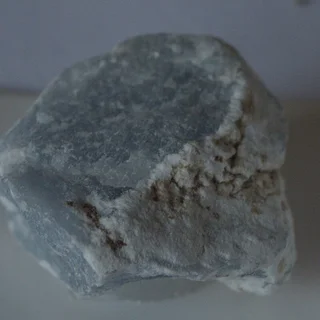

Angelite: Meaning, Crystal Healing Properties, and Effects
A comprehensive guide to Angelite, covering the origins of its crystal meanings ("Angelic Protection, Honest Dialogue, Gentleness"), its characteristics as Anhydrite, the visual effects of its pale sky-blue color, its reputed benefits, complementary stones, care methods, and frequently asked questions.
Table of Contents (Tap to toggle)
Introduction
Known as the "Angel Stone," Angelite is a powerful crystal widely cherished in the modern spiritual community as "a stone that helps facilitate communication with angels." Its soft, pale sky-blue hue is reminiscent of clouds floating in the sky. As a protective charm that is said to foster gentleness and support honest dialogue, it quietly comforts those struggling with human relationships.
This article provides a comprehensive overview, from the origins of its crystal meanings to its mineralogical characteristics, why it's called the "Angel Stone," its reputed benefits, care methods, differences from Selenite and its sensitivity to water, and frequently asked questions. It is structured to serve as a comprehensive guide for anyone seeking "improved communication and gentle relationships."
Table of Contents
- Basic Information and Mineral Data
- Crystal Meanings, History, and Cultural Background
- Reputed Benefits and Effects
- Ways to Use Angelite for Communication and Gentle Dialogue
- Complementary Stone Combinations
- Cleansing and Care Methods
- How to Distinguish Natural and Similar Stones
- Frequently Asked Questions (FAQ)
- Editor's Notes
- Our Editorial Team's Perspective
- Related Articles You Might Also Enjoy
Basic Information and Mineral Data
| Item | Content |
|---|---|
| Stone Name | Angelite |
| Japanese Name | Anhydrite (Hard Gypsum) |
| Mineral Species | Calcium Sulfate (Anhydrous Gypsum) |
| Crystal System | Orthorhombic |
| Primary Sources | Peru, Egypt, Libya, Mexico, Germany |
| Mohs Hardness | 3-3.5 (relatively soft) |
| Specific Gravity | 2.90-3.00 |
| Refractive Index | 1.569-1.614 |
| Color | Pale sky-blue to light blue (sometimes with white inclusions) |
Angelite is a pale blue to sky-blue variety of anhydrite (CaSO₄), a mineral whose blue color is attributed to trace amounts of strontium. It belongs to the same calcium sulfate family as Selenite (CaSO₄·2H₂O), with the key distinction being its lack of water molecules.
The name "Angelite" is a trade name or commercial name and not its formal mineralogical designation. When blue anhydrite was discovered in Peru in 1987, it was commercially named "Angelite" due to its sky-like color and its symbolism as a "healing vibration reminiscent of angels." It is important to understand that this is a modern trade name born from the context of the New Age movement.
With a Mohs hardness of 3-3.5, it is relatively soft for a gemstone and can be scratched by a fingernail. It is also sensitive to water, and prolonged immersion can cause surface degradation. The key to a long-lasting relationship with Angelite is to treat it more as a "healing stone for display" than as "jewelry to wear."
Crystal Meanings, History, and Cultural Background
Angelite's crystal meanings are "Angelic Protection, Honest Dialogue, Gentleness, and Acceptance."
While known mineralogically as anhydrite since the 19th century, the blue variety began circulating widely under the name "Angelite" after 1987. Discovered in Peru, this pale blue stone quickly spread throughout the global healing community due to its symbolism as "a stone that aids communication with angels."
Within the New Age movement, there's a belief that "angels wish to speak with humans, but humans are too busy to notice," and Angelite has been regarded as a stone that helps facilitate this "awareness." Its pale sky-blue color visually evokes "the realm of the sky and clouds, where angels are said to reside," supporting the sensation of "looking up and listening quietly"—such symbolic uses underscore its modern popularity.
In Japan, it became widely known alongside the "angel and spiritual boom" from the 2000s onwards. It continues to be cherished as a stone that deeply resonates with modern emotional needs such as "desiring to feel watched over" and "seeking gentle dialogue."
Sources: GIA (Gemological Institute of America) overview of anhydrite, AGTA (American Gem Trade Association) mineralogical data, and others.
Recommended for those who:
- Wish to improve dialogue and communication with loved ones.
- Are seeking a sense of being watched over and gentleness.
- Want to calm anger and irritation, and strive for peaceful dialogue.
- Are interested in angels and spiritual beings.
Reputed Benefits and Effects
Note: The "effects" of crystals are cultural and symbolic in nature. They are not medically or scientifically guaranteed, and individual experiences may vary.
- Symbol of Angelic Protection — Believed to support a "sense of being watched over."
- Honest Communication — Often associated with the 5th Chakra (Throat Chakra), said to evoke the courage and gentleness needed to speak one's truth.
- Calming Anger and Conflict — Acts as a protective charm to help regain "the capacity to understand others."
- Compassion and Tolerance — Believed to cultivate an attitude of "treating oneself and others with kindness."
- Peaceful Sleep — Its pale sky-blue color aligns with visual effects that soothe the parasympathetic nervous system.
Regardless of whether you believe in these traditional "effects," the fact that gazing at a pale sky-blue color can calm one's mind is also supported by color psychology. Angelite, which can replicate the feeling of "gazing at the sky" in your hand, serves not only as a protective charm but also as a "visual healing stone" that quietly integrates into a stressful life.
Note: Angelite's "angel communication effect" is spiritual symbolism and has not been medically or scientifically verified. Enjoying it as a protective charm is its true purpose.
Ways to Use Angelite for Communication and Gentle Dialogue
- As a Pendant at the Throat (around the Throat Chakra) Associated with the 5th Chakra (Throat Chakra), this is a classic way to wear it, supporting honest expression and dialogue skills. Many users wear it before important conversations, counseling sessions, or speeches.
- Place on a Desk or in a Dialogue Space A traditional practice involves placing it on a desk when preparing for an important conversation. Counselors, teachers, and sales professionals often place it on their desks to support an attitude of sincere engagement with others.
- Place by Your Pillow or on a Side Table As a charm for sleeping while feeling watched over by angels. Rather than directly under your pillow, the classic method is to place a small tumbled stone on a side table or shelf.
- As a Bracelet on the Left Wrist The left side is believed to correspond to "receiving" energy. Ideal for periods when you wish to attract gentleness and improved dialogue. As it is a soft stone, care must be taken to avoid strong friction.
- In Your Palm During Meditation or Prayer A traditional practice involves holding a palm-sized tumbled stone while "speaking" to a "being that watches over you" during spiritual practice.
Complementary Stone Combinations
| Combination | Expected Meaning |
|---|---|
| Angelite and Selenite | The ultimate angelic pair. Dual support for protection and purification. |
| Angelite and Labradorite | Angelic and spiritual synergy. For when you wish to connect with higher dimensions. |
| Angelite and Turquoise | Blue-toned combination; protection for travel and dialogue. |
| Angelite and Rose Quartz | Harmony of love and gentle dialogue. For family and partner relationships. |
| Angelite and Clear Quartz (Crystal) | Purification and amplification. Clear Quartz balances Angelite's delicacy. |
It is said that combining too many stones can disperse their individual energies. Angelite serves the gentle role of "peaceful dialogue," so simply pairing it with one or two other stones is a sustainable way to use it.
Cleansing and Care Methods
With a Mohs hardness of 3-3.5, Angelite is soft and sensitive to water, requiring delicate handling.
Acceptable Cleansing Methods:
- Place on a Quartz Cluster or Tumbled Stones: The safest and most common method.
- Pass Through White Sage Smoke: 1 to 2 minutes is sufficient.
- Moonlight Bath: Place near a window for 3 days around the full moon.
- Sound Bath with a Tuning Fork or Crystal Tuner: Effective if it does not touch metal.
Methods to Avoid:
- Water/Running Water (Anhydrite readily absorbs moisture, leading to surface degradation).
- Coarse Salt (may absorb moisture and damage the surface).
- Ultrasonic Cleaner (risk of expanding cracks).
- Prolonged Direct Sunlight (risk of fading for its pale blue color due to UV rays).
- Long-term Storage in Humid Places (moisture can damage the crystal structure).
For daily care, simply lightly wipe with a soft, dry cloth. Never washing it with water is the absolute rule for a lasting relationship with Angelite.
How to Distinguish Natural and Similar Stones
- Natural Angelite has a soft, pale sky-blue hue and naturally exhibits slight whitish mottling.
- Confusion with Selenite: Though both are calcium sulfates and similar in appearance, Selenite exhibits a transparent to white fibrous luster, while Angelite has a uniform pale blue texture.
- Confusion with Dyed Magnesite: Magnesite dyed blue sometimes circulates as "Angelite-like." Can be distinguished by touch and specific gravity.
- Confusion with Howlite Turquoise (Dyed Howlite): Dyed howlite is a more vivid blue, while Angelite is a paler sky-blue—distinguishable by color.
- Glass Imitations: Plastic and glass imitations also exist. Can be distinguished from genuine stone by specific gravity, coolness to the touch, and texture.
- Choosing one with a gemstone certificate is the most reliable method.
The essence of choosing Angelite lies in its soft, pale sky-blue color. A blue that is too vivid or artificially uniform is a sign to suspect dyed or similar stones.
Frequently Asked Questions (FAQ)
Q1. How many years can Angelite be worn?
A. With a Mohs hardness of 3-3.5, it is relatively soft for a gemstone and can be scratched by a fingernail. If handled carefully, avoiding strong impact, friction, and water, it can be enjoyed for several years. However, it is not a type of stone meant to be passed down through generations, like diamonds or sapphires. It is more realistic to approach it as a "charm for a few years."
Q2. Is it okay to wear Angelite in the bath, pool, or during sports?
A. Please consider all of these to be 'not okay.' As it is fatally sensitive to water, hot water, pools, hot springs, and sweat during sports—all will degrade Angelite. "Keep it absolutely away from water" is the cardinal rule for Angelite.
Q3. Angelite and Selenite: Which is stronger for "angelic connections"?
A. Both are spoken of as "angelic healing stones," but they are said to have different personalities:
- Angelite: Pale sky-blue. Supports "communication and dialogue with angels."
- Selenite: Transparent moon goddess stone. Possesses the "power to purify other stones." The correct approach is to choose based on your purpose, and many enthusiasts even carry both as a pair.
Q4. Can Angelite help one "talk to angels"?
A. This is a widely discussed efficacy as spiritual symbolism, but it has not been medically or scientifically verified. Its true purpose is to be a protective charm that supports feelings such as "desiring to feel watched over" and "wishing to have quiet moments looking up at the sky."
Q5. What is the difference between Angelite and Howlite Turquoise (Dyed Howlite)?
A. Angelite is natural pale sky-blue anhydrite, while Howlite Turquoise is white howlite that has been dyed blue. They are entirely different minerals. They can be distinguished by differences in color (Angelite is paler, dyed howlite is more vivid) and texture (Angelite is uniform, dyed howlite often has a web-like pattern).
Q6. What if my Angelite accessory chips or degrades due to water?
A. In the world of crystals, it's traditionally interpreted as the stone "acted as a proxy or shield" for you. As it is a soft and delicate stone, chipping or degradation is not uncommon. It is common practice to return it to the earth with gratitude or carefully store it away in a drawer. Its affordable price point also makes it easy to welcome a new stone, which is a positive aspect of Angelite.
Editor's Notes
Angelite has always been a stone that "gave me a reason to look up." During a period when I was overwhelmed by work and tended to look down, I remember somehow picking up a tumbled stone that the shop owner recommended at a healing store I happened to visit, saying, "It's like the color of the sky, isn't it?"
Living with it on my desk, just "feeling the pale sky-blue in the corner of my vision" unexpectedly increased how often I'd look up at the sky outside the window—a small change like that occurred. Whether I could talk to angels or not, the moments when I felt that "something watching over me" might be somewhere in the sky increased amidst my busy daily life.
Angelite is not a "flashy stone." However, I believe that the presence of its pale sky-blue hue gently softens the everyday scenery—it is a stone that brings the kind of healing we need in modern life.
Our Editorial Team's Perspective: Its Value as a "Prompt to Look Up"
A crucial point to remember when choosing Angelite is not to expect to "talk to angels." In reality, its essential value lies in being a "visual healing stone that creates opportunities to look up."
| Evaluation Factor | Importance |
|---|---|
| Paleness of sky-blue | ◎ Most important. A balance of not too vivid, not too pale. |
| Color uniformity | ○ Slight mottling is acceptable. Artificially uniform color suggests a dyed product. |
| Surface smoothness | ○ As a soft stone, meticulous polishing helps preserve its beauty. |
| Size and shape | ○ Depends on use. Tumbled stones (small), raw stones (larger). |
| Overall size | △ Visual effects are similar even with smaller sizes. |
In short—
- ❌ "Angelite = a stone that allows direct communication with angels" → ✅ Spiritual symbolism. Its true value lies in being a protective charm.
- ❌ "Can substitute Selenite" → ✅ They are distinct with different roles. Selenite is a purification tool, while Angelite is a charm for dialogue.
- ❌ "Can be lightly washed with water" → ✅ Absolutely NOT. It is fatally sensitive to water.
Sun-chan's Little Message☀️
Thank you for choosing Angelite☁️💙
This little one, you see, is a stone that helps you look up at the sky on days when you tend to look down. Even in your busy daily life, it brings moments when you "suddenly pause and remember the sky"✨
Whether you can talk to angels, I don't know. But the feeling of believing that "something is watching over you" will make you gentle—and that alone is enough💛
Related Articles You Might Also Enjoy
- Selenite: Meaning and Effects — The ultimate angelic pair; the transparent stone of the Moon Goddess that purifies other stones.
- Labradorite: Meaning and Effects — Angelic and spiritual synergy; the stone of intuition embodying the aurora.
- Turquoise: Meaning and Effects — Blue-toned combination; protection for travel and dialogue.
- Rose Quartz: Meaning and Effects — Harmony of love and gentle dialogue.
- Aquamarine: Meaning and Effects — Another pale blue stone; a stone for peaceful dialogue.
- Crystals for Improving Relationships — Compare Angelite's positioning in the chapter on dialogue and communication.
- How to Properly Wear Crystals — Distinguishing left and right usage and maximizing effects.
Summary
- Angelite symbolizes "angelic protection, honest dialogue, and gentleness"; it is a pale blue variety of anhydrite.
- A relatively new trade name/commercial name discovered in Peru in 1987. Widely popularized within the context of the spiritual movement.
- The "ability to speak with angels" is spiritual symbolism. Enjoying it as a protective charm is its true purpose.
- Purify with tumbled stones, sage, or moonlight. Fatally sensitive to water—"keep it absolutely away from water" is the cardinal rule.
- Since individual experiences of its effects vary, it's recommended to approach it casually as a "protective charm."
A pale sky-blue stone that "brings a reason to look up"—a modern healing partner that creates quiet moments in a busy daily life.
Tags
この記事をシェアする
この記事が役に立ったら、SNSでシェアしていただけるととても嬉しいです☀️

Thanks so much for reading! I hope this article brought a little sunshine to your day! See you again soon!
You might also like

Apatite: Meaning, Stone Lore, and Effects
A comprehensive guide to Apatite: Its meaning, stone lore ('Communication, Academics, Goal Achievement'), effects, who it's recommended for, compatible stones, and purification methods. Discover the basics and practical uses of this 'Blue Guiding Stone' that helps you achieve your goals, all on one page.
Seraphinite: Meaning, Stone Lore, and Effects
A comprehensive guide to Seraphinite, covering its meaning, stone lore ('Angels, High-Vibration Healing, Spirituality'), effects, who it's recommended for, compatible stones, and purification methods. Discover the fundamentals and practical uses of this 'High-Vibration Healing Stone' that carries angelic feathers, all on this single page.

How to Properly Wear Crystals
It's believed that the meaning of crystals changes depending on whether you wear them on your left or right hand. This beginner's guide provides a complete explanation of how to properly wear bracelets, pendants, rings, and earrings, how to align them with chakras, where to place them in your home, and even when not to wear them.

Moonstone Meaning, Stone Properties, and Effects
A comprehensive guide to moonstone's properties, history, lore surrounding femininity, intuition, and new moons, ideal pairings, mineral data, and FAQs. This is your go-to resource for incorporating this milky white stone, revered as the embodiment of the moon from ancient India to Rome, into your life.