
Sodalite Meaning, Stone Properties, and Benefits
Comprehensive guide to Sodalite's meaning, stone properties ('Logic, Academia, and Conviction'), benefits, recommended users, compatible stones, and purification methods. Discover the fundamentals and practical uses of this 'Stone of Thought and Conviction' perfect for any scholar's desk.
Table of Contents (Tap to toggle)
Introduction
Sodalite is a sodium-rich silicate mineral discovered in 1811 within Greenland's Ilimaussaq Complex. For a while after its discovery, it was treated mainly as an academic sample. However, in 1891, a massive deposit was found in Ontario, Canada, and it's said that the stone captivated Princess Louise (British royal princess), who was visiting Canada at the time, leading to its rapid surge in popularity among European courts.
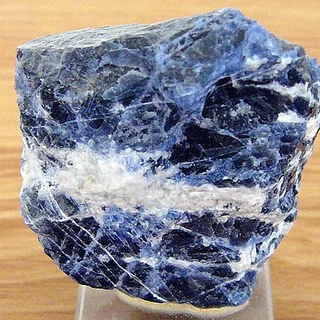
Its deep navy blue base, interwoven with striking white calcite streaks, creates a unique appearance reminiscent of a night sky. It's well-known for often being confused with Lapis Lazuli. Because it gained prominence after mineralogy was established as a science in the 19th century, Sodalite is now referred to as the "Stone of Thought" and the "Scholar's Stone." It's cherished by researchers, students, and professionals for its ability to support logic, intellect, and calmness.
Basic Information
| Item | Details |
|---|---|
| Stone Name | Sodalite |
| Mineral Species | Sodium Silicate Mineral |
| Main Sources | Brazil, Canada, Namibia |
| Mohs Hardness | 5.5 to 6 |
| Color | Blue with white streaks |
| Associated Chakras | Fifth (Throat) / Sixth (Third Eye) |
Stone Properties and Meaning
Sodalite is said to symbolize "Logic, Academia, and Conviction." As the "Stone of Thought and Conviction" ideal for a scholar's desk, it has been beloved worldwide for a long time.
Sodalite is also known as "Princess Blue." This name originates from an anecdote that in 1891, when Princess Louise visited Canada, she was deeply moved by the beauty of the Sodalite deposit in Bancroft, Ontario. She brought a large quantity of raw stones back to England and used them to decorate her palace.
In a spiritual context, the blue wavelength is believed to correspond simultaneously with the "Throat Chakra (communication)" and the "Third Eye Chakra (intuition and thought)." It has therefore been positioned as a stone symbolizing "the ability to organize thoughts and express them clearly." It is a stone long supported by those in professions that involve "thinking and conveying," such as students preparing for exams, business professionals who give many presentations, researchers, and writers.
Recommended for those who:
- Are preparing for exams or tests
- Want to think logically
- Are easily swayed by others
- Are engaged in creative work
Alleged Benefits
Note: The "effects" of crystals are cultural and symbolic meanings. They are not medically or scientifically guaranteed.
- Enhances logical thinking: Believed to correspond to the Sixth Chakra, it is said to help organize thoughts.
- Improves academic performance and intellect: Known as the "Scholar's Stone," it is also associated with academic success.
- Upholds convictions: Inspired by the "Princess Blue" anecdote, it is believed to grant the strength to follow one's own will.
- Promotes calmness: The blue wavelength is said to soothe emotions, assisting in making judgments without being swayed by feelings.
Examples of Use
- Wear as a bracelet: Traditionally worn on the dominant hand as a talisman to support concentration during work or study.
- Wear as a pendant around the neck: Believed to act on the Fifth Chakra, a position said to help regain calmness before speaking.
- Place on your desk or bedside table: Placing it on the top left of a study or work desk is considered the "Scholar's Stone Feng Shui Placement."
- Carry it with you: A classic way to use it is to slip a tumbled stone into your pocket before a presentation, interview, or exam.
Sodalite versus Lapis Lazuli
| Comparison Item | Sodalite | Lapis Lazuli |
|---|---|---|
| Coloration | Deep navy blue to blue, with white streaks | Ultramarine blue, with golden pyrite specks |
| Price Range | Relatively affordable | Expensive (especially from Afghanistan) |
| Mineral Composition | Single mineral (Sodalite) | Aggregate of multiple minerals |
| Hardness | 5.5 to 6 | 5 to 5.5 |
| Symbolism | Logic, Calmness, Academia | Wisdom, Spirituality, Good Fortune |
If you understand Sodalite as "the blue of logic and intellect" and Lapis Lazuli as "the blue of spirituality and good fortune," it becomes easier to choose between them.
Compatible Combinations
| Combination | Expected Meaning |
|---|---|
| Sodalite and Clear Quartz | Amplifies thought. |
| Sodalite and Amethyst | Balances intellect and intuition. |
| Sodalite and Lapis Lazuli | The ultimate duo for wisdom and conviction. Ideal for academic and intellectual professions. |
| Sodalite and Citrine | Balances logic and action. Good for career success. |
Purification Methods
Suitable Methods:
- Clear Quartz geode or tumbled stones
- White sage
- Moonlight bathing
Methods to Avoid:
- Prolonged direct sunlight
- Salt
Market Price Range
Here's an estimated price range for commercially available Sodalite (as of 2026, for A to AA grade items):
| Form | Market Price |
|---|---|
| Bracelet (approx. 8mm beads) | ¥2,000 to ¥5,000 |
| Tumbled stone or chips (50g) | ¥800 to ¥2,500 |
Relatively stable market price. Those with beautiful contrast between deep blue and white streaks are highly valued.
Prices can vary significantly depending on the origin, grade, and size. It's recommended to compare products with certification, clarity, and color intensity across multiple stores before making a purchase.
How to Identify Fakes and Artificial Stones
- Natural stones inherently display color variations, minor inclusions, and cracks. This is their natural state.
- If the transparency or color saturation is too uniform, it might be glass, an artificial stone, or a dyed stone.
- Sodalite is sometimes sold as a substitute for Lapis Lazuli, so check for white streaks and the absence of golden flecks (pyrite).
- The more popular the stone, the more likely counterfeits are to appear. Purchasing from a trusted specialty store with a certificate of authenticity offers peace of mind.
Frequently Asked Questions (FAQ)
Q. Sodalite or Lapis Lazuli for academic success? A. Strictly speaking, Sodalite is said to be more suitable for logical thinking and organizing memories, while Lapis Lazuli is for intuitive judgment involving flashes of insight and inspiration. Some people differentiate their use, opting for Sodalite for logical subjects (mathematics, physics, and law) and Lapis Lazuli for creative fields (composition and art).
Q. What form is best to give to a student preparing for exams? A. Tumbled stones or raw crystals that can be placed on a desk are classic choices. Even if a bracelet cannot be brought into an examination hall, a small raw crystal can be placed on the desk to accompany the student while studying, making it a popular gift.
Q. Are products labeled "Princess Blue" authentic? A. "Princess Blue" is one of Sodalite's nicknames and does not refer to a different mineral. However, as it is a common name, it is difficult to determine authenticity based on the notation alone. It is safer to confirm by checking the origin and the presence of a certificate of authenticity.
Q. Is it appropriate for male business professionals to wear? A. Its calm navy blue pairs well with suits, making it one of the most suitable crystals for business settings. It is also available as tie pins and cufflinks.
Related Articles You Might Enjoy Reading
- Complete Guide to Choosing Crystals
- Complete Guide to Crystal Purification Methods
- Lapis Lazuli Meaning, Stone Properties, and Benefits
- Amethyst Meaning, Stone Properties, and Benefits
- Citrine Meaning, Stone Properties, and Benefits
Editor's Note
Sun-chan feels that Sodalite is not a stone you buy for extravagant blessings, but rather one that quietly stays by your side on your desk. We've received many messages from readers who, after placing Sodalite on the top left of their desk for months leading up to a qualification exam, spontaneously wanted to thank it after passing – that's the kind of stone Sodalite is!
Summary
- Sodalite is a crystal symbolizing "Logic, Academia, and Conviction."
- Enhances logical thinking: It is considered a stone that organizes thoughts.
- Improves academic performance and intellect: It is also known as a stone for academic success.
- For purification, Clear Quartz chips and white sage are suitable. It is recommended to avoid prolonged direct sunlight.
Each time you wear it, it reminds you of "logic" – Sodalite is a stone with which you can have such a relationship.
Tags
この記事をシェアする
この記事が役に立ったら、SNSでシェアしていただけるととても嬉しいです☀️

Thanks so much for reading! I hope this article brought a little sunshine to your day! See you again soon!
You might also like

Apatite: Meaning, Stone Lore, and Effects
A comprehensive guide to Apatite: Its meaning, stone lore ('Communication, Academics, Goal Achievement'), effects, who it's recommended for, compatible stones, and purification methods. Discover the basics and practical uses of this 'Blue Guiding Stone' that helps you achieve your goals, all on one page.

How to Properly Wear Crystals
It's believed that the meaning of crystals changes depending on whether you wear them on your left or right hand. This beginner's guide provides a complete explanation of how to properly wear bracelets, pendants, rings, and earrings, how to align them with chakras, where to place them in your home, and even when not to wear them.

Moonstone Meaning, Stone Properties, and Effects
A comprehensive guide to moonstone's properties, history, lore surrounding femininity, intuition, and new moons, ideal pairings, mineral data, and FAQs. This is your go-to resource for incorporating this milky white stone, revered as the embodiment of the moon from ancient India to Rome, into your life.
Pyrite (Iron Pyrite): Meaning, Stone Language, and Effects
A comprehensive guide to Pyrite (Iron Pyrite), covering its meaning, 'stone language' (financial luck, willpower, and warding off evil), effects, who it's recommended for, compatible stones, and purification methods. Discover the essentials and practical applications of this symbol of prosperity, famously known as 'Fool's Gold,' all in one place.