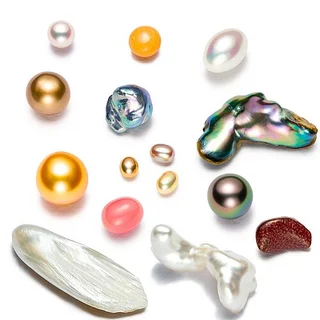

Pearl: Meaning, Gemstone Language, and Effects
A comprehensive guide to June's birthstone, Pearl, covering the origins of its gemstone meanings 'Purity, Health, and Longevity,' its characteristics as an organic gemstone, detailed explanations of Akoya, South Sea, Tahitian, and Freshwater types, its purported effects, compatible stones, care methods, and frequently asked questions.
Table of Contents (Tap to toggle)
Introduction
Known as the "Jewel of the Ocean," the pearl is the only gemstone of biological origin formed within a shell. Unlike mineral gemstones, it possesses a soft, milky white luster (teri) and has long symbolized "purity, health, and longevity" as June's birthstone.
This article provides a thorough overview, from the origins of its gemstone meanings and biological characteristics to the differences between Akoya, South Sea, Tahitian, and Freshwater types. We will also cover its purported effects, care methods, how to distinguish genuine, cultured, and imitation pearls, etiquette for ceremonial occasions, and frequently asked questions. It's designed to be a definitive guide for those who not only admire pearls as a cherished jewel but also wish to deeply understand them as "a stone that accompanies life's milestones."
Table of Contents
- Basic Information and Mineral Data
- Gemstone Meanings and Historical/Cultural Background
- Purported Effects
- Ways to Enhance Femininity and Health
- Compatible Combinations
- Cleansing and Care
- Distinguishing Genuine, Cultured, and Imitation Pearls
- Frequently Asked Questions (FAQ)
- Editor's Note
- Editorial Team's View
- Related Articles You Might Enjoy
Basic Information and Mineral Data
| Item | Content |
|---|---|
| Stone Name | Pearl |
| Japanese Name | 真珠 (Shinju) |
| Mineral Species | Organic Gemstone (Calcium Carbonate + Conchiolin) |
| Crystal System | Orthorhombic (Aragonite crystal structure) |
| Main Producing Regions | Japan (Akoya), Australia (South Sea), Tahiti (Tahitian), China (Freshwater) |
| Mohs Hardness | 2.5 to 4.5 (Extremely soft) |
| Specific Gravity | 2.65 to 2.85 |
| Colors | White, cream, pink, gray, black, gold, and various others |
Pearls are formed within Akoya oysters, Pinctada maxima (South Sea oysters), Pinctada margaritifera (Tahitian black-lip oysters), and freshwater mussels (such as Hyriopsis cumingii). They are created when calcium carbonate (aragonite) and conchiolin (protein) are layered around an irritant. As a gemstone where the biological process itself crystallizes, pearls are truly unique, distinct from mineral gemstones.
With a Mohs hardness of 2.5 to 4.5, pearls are extremely soft for a gemstone, and their biggest weakness is their vulnerability to sweat, cosmetics, perfume, and acidic substances. For daily wear, it's essential to develop the habit of "wiping pearls after wearing them," and the basic etiquette is to remove them before water activities, applying makeup, or exercising.
Types of Pearls
- Akoya Pearls: Traditional Japanese cultured pearls, typically 6-9mm in diameter, known for their elegant white to pinkish luster.
- South Sea Pearls (White Lip Pearls): Produced in Australia and Indonesia, these are large pearls, 10-18mm, in white to golden hues.
- Tahitian Pearls (Black Lip Pearls): From Tahiti, typically 8-15mm, with colors ranging from green to peacock, gray, and black.
- Freshwater Pearls: Primarily from China, these pearls come in a wide variety of shapes and are more affordable. Examples include baroque, rice, and button shapes.
Gemstone Meanings and Historical/Cultural Background
The gemstone meanings of pearl are "purity, health, longevity, wealth, and vibrant beauty." Its etymology is derived from the Latin word 'perna,' meaning bivalve.
In ancient Rome, the legend of Queen Cleopatra famously dissolving a pearl in vinegar and drinking it is known as a symbol of wealth and power (regardless of its actual scientific veracity, it's a widely known cultural story). In medieval Europe, pearls were called "Tears of the Moon" and "Tears of Mermaids," treated as sacred jewels offered to the goddesses of the moon and sea.
In Japan, pearls have been celebrated as "shiratama" (white jewels) since the Kojiki and Manyoshu eras, and they continue to hold a special place as formal jewelry for ceremonial occasions (weddings, funerals, graduation ceremonies, etc.) today. In 1893, Kokichi Mikimoto successfully cultivated Akoya pearls for the first time in the world, leading to the widespread availability of pearls that were previously only obtained through natural harvesting. Japan is still known as a producer of the world's highest quality Akoya pearls.
The British Royal Family, including Queen Elizabeth, Princess Diana, and Princess Catherine, have consistently worn pearls at ceremonial events, maintaining their status as "the Queen's jewel."
Source: GIA (Gemological Institute of America) Pearl Overview, Japan Pearl Promotion Society materials, and others.
Recommended for these people
- Those seeking a charm that symbolizes purity, femininity, and motherhood.
- Those wishing for health and longevity (also a great gift for family).
- Those who want one essential piece of jewelry for ceremonial occasions.
- Those looking for a gift for themselves, family, or a partner born in June.
Purported Effects
Please Note: The "effects" of crystals are cultural and symbolic meanings. They are not medically or scientifically guaranteed, and individual experiences may vary.
- Symbol of Purity and Inner Beauty — Believed to protect the purity of the heart.
- Support for Femininity and Motherhood — As a symbol of the moon and sea goddesses, it is said to accompany women through various life stages.
- Wish for Health and Longevity — Has been cherished as an "amulet for health" since ancient times.
- Bond of Family and Marriage — Passed down from mother to daughter as jewelry, weaving the bond itself.
- Symbol of Healing Sorrow — From the legend of "Mermaid's Tears," wearing it at funerals has become a custom.
Regardless of whether you believe in these traditional "effects," the fact that observing the soft, milky white luster can calm one's mind is also spoken of from a color psychology perspective. White and milky white are considered colors that regulate the parasympathetic nervous system, and pearls, as a symbolic presence, are widely beloved for ceremonial occasions and everyday wear.
Ways to Enhance Femininity and Health
- As a Pendant or Necklace Around the Neck This is the classic way to wear pearls. A single-strand necklace is essential for ceremonial occasions, and the soft light gently swaying around the neck also has the effect of brightening the complexion.
- As Earrings or Piercings on the Ears Single pearl studs are versatile jewelry suitable for both ceremonial occasions and daily wear. A size of around 8mm is generally acceptable for both weddings and funerals.
- For Formal Attire at Ceremonial Occasions In Japan, pearls are chosen for all "life's milestone ceremonies," such as weddings, funerals, and graduation/entrance ceremonies. The basic rule is: "white pearls are acceptable for both celebratory and mourning occasions," while "black pearls are primarily for mourning" (though regional differences apply).
- As a Family Heirloom Passed from Mother to Daughter Though a soft stone, with proper storage and care, pearls can be passed down through generations. The unique Japanese custom of "wearing mother's pearls for Coming-of-Age Day" continues to this day.
- As a Bracelet on the Left Wrist The left side is believed to correspond to the energy of "receiving." Wear it when you want to bring out your femininity and gentleness.
Compatible Combinations
| Combination | Expected Meaning |
|---|---|
| Pearl and Moonstone | Both June birthstones, offering dual support for femininity and intuition. |
| Pearl and Aquamarine | A combination of sea and sea, wishing for a peaceful married life. |
| Pearl and Rose Quartz | Harmony of purity and love, symbolizing motherhood and femininity. |
| Pearl and Clear Quartz (Crystal) | Cleansing and amplification. Clear quartz harmonizes the pearl's delicacy. |
| Pearl and Diamond | Purity and indomitability. The ultimate combination for ceremonial occasions. |
It is said that increasing the number of combinations too much can dilute the energy of each stone. Since a pearl is a complete gemstone on its own, it's a long-lasting style to simply add one or two complementary stones without overdoing it.
Cleansing and Care
Pearls are extremely delicate gemstones. Many common crystal cleansing methods are NOT suitable, so please learn these specific care instructions.
OK Cleansing Methods:
- Gently wipe with a dry, soft cloth: The safest and almost only method for daily cleansing.
- Pass through white sage smoke: For 1-2 minutes (without direct contact).
- Moonlight bath: Place near a window 3 days before or after a full moon. Pearls have a deep connection to the moon.
Absolute NG Cleansing Methods:
- Washing with water or running water: Conchiolin dissolves, and the surface luster will be lost.
- Coarse salt: Damages the surface and permanently removes the luster.
- Ultrasonic cleaners: Risk of internal conchiolin detaching.
- Prolonged exposure to direct sunlight: Causes discoloration and dehydration.
- Cosmetics, perfumes, hairsprays: Always apply makeup and style hair before putting on pearls.
Daily care boils down to: "Always wipe your pearls with a dry, soft cloth after wearing them." If sweat, sebum, or cosmetics are left on them, the surface luster will be permanently lost within 5-10 years. For long-term storage, keep them in a silk or soft cloth pouch, in a place where they won't touch other jewelry.
Distinguishing Genuine, Cultured, and Imitation Pearls
- Genuine Pearls (Natural and Cultured): When gently rubbed against your teeth, they feel "gritty" (due to their layered nacre structure).
- Imitation Pearls (Fake Pearls): Glass or plastic coated on the surface. When rubbed against your teeth, they feel "smooth."
- Cultured and Natural: Over 99% of pearls are cultured. Cultured pearls involve inserting a nucleus into the oyster to grow, while natural pearls form completely spontaneously. Natural pearls are rare, costing millions of yen (hundreds of thousands of dollars) per piece.
- Surface Texture: Genuine pearls are not perfectly spherical and have slight irregularities (growth lines).
- Weight: Plastic imitations are noticeably light. Glass imitations are slightly heavier than genuine pearls.
- The most reliable way is to choose pearls with a grading report (e.g., CIBJO, Japan Pearl Promotion Society).
The common misconception that "cultured pearls are fake" is incorrect; cultured pearls are genuine pearls. Because real nacre layers form inside the Akoya oyster, their chemical composition and luster are identical to natural pearls. Due to the balance of price and availability, almost all pearls in modern circulation are cultured.
Frequently Asked Questions (FAQ)
Q1. How long can pearls be worn?
A. If handled correctly, they can be passed down for decades, even generations. However, they are vulnerable to sweat, cosmetics, water, and friction, so the habit of "always wiping them dry after wearing" is an absolute condition for longevity. It's recommended to have necklaces restrung by a specialist every 5-10 years to prevent loss due to thread breakage.
Q2. Is it okay to wear them in the bath, pool, or during sports?
A. Absolutely not for any of these activities. Hot water, chlorine, sweat, and friction are all major enemies of pearls. The basic rule is to always remove them before bathing, exercising, or applying makeup. The traditional Japanese jewelry etiquette of "put on last, take off first" is precisely a wisdom to protect pearls.
Q3. What is the etiquette for wearing pearls at ceremonial occasions?
A. Basic Rules:
- White Pearls: Acceptable for both celebratory and mourning occasions (versatile).
- Black Pearls: Primarily for mourning (though acceptable for some celebratory events, regional differences apply).
- Size: 7-8mm is acceptable for both; 9mm and larger are more for celebratory events; 6mm and smaller are more for mourning.
- Strands: For mourning, only a single-strand necklace is appropriate (double strands can imply 'misfortune piling up,' making them unsuitable).
- Earrings/Piercings: Single stud types are acceptable for both.
Q4. What if pearls yellow or lose their luster?
A. If the damage is minor, cleaning and reprocessing at a specialized store can sometimes restore them. For severe damage, complete restoration is difficult, but it may be possible to re-sort and re-string the pearls for a necklace to maintain their appearance. Consult specialists like Mikimoto or Tasaki.
Q5. Can I wear pearls even if I'm not born in June?
A. Of course! They are an essential item for ceremonial occasions and a piece of jewelry to own for life, regardless of your birth month. They also serve as a family heirloom passed from mother to daughter, cherished as a gemstone that accompanies women throughout all stages of life.
Q6. Akoya, South Sea, Tahitian, Freshwater – which should I choose?
A. It depends on your purpose:
- Formal wear for ceremonial occasions: Akoya (traditional Japanese, elegant).
- Large and glamorous: South Sea (large, impactful presence).
- To express individuality: Tahitian (peacock green and other unique colors).
- Affordable for versatile daily use: Freshwater (baroque shapes, casual wear).
Editor's Note
For me, the operator, a pearl necklace was "the first piece of jewelry I inherited from my mother." The night before my Coming-of-Age Day ceremony, my mother took out a strand of white pearls from a box and handed them to me, saying, "These were your grandmother's." I still vividly remember the feeling that a single strand of white light was connecting the lives of three generations of women.
Pearls are not "flashy stones." Yet, the soft warmth they impart when resting on your neck is unlike any other gemstone. The fact that "they are gemstones created by living creatures" is a quiet realization that comes with every wear—they are truly a mysterious presence.
Pearls are unique partners, capable of quietly accompanying us through life's milestones, ceremonial occasions, and even the smallest moments of everyday life—a "gemstone that lives on through generations."
Editorial Team's View: Luster (Teri) and Nacre Thickness ('Maki') are Essential
A common misconception when choosing pearls is to select them based only on size and color. In reality, the most crucial factors determining a pearl's value are its "teri" (luster) and "maki" (nacre thickness).
| Evaluation Factor | Importance |
|---|---|
| Teri (Luster) | ◎ Most Important. Whether it has a mirror-like reflection. |
| Maki (Nacre Thickness) | ◎ Important. Thicker nacre means better durability and luster. |
| Blemishes (Bumps/Dimples) | ○ The fewer, the better, but zero is rare. |
| Color | ○ Subject to preference. Pinkish hues are popular; greenish hues are rare. |
| Shape | △ Round is classic, but baroque shapes can also have value as unique pieces. |
| Size | △ Larger pearls are more expensive but depend on the use (around 8mm is versatile). |
In other words:
- "Teri" is more important than "size."
- "Maki" is more important than "color."
- "Shape" depends on the occasion (round for ceremonial events, baroque also fine for casual wear).
Common Misconceptions
- ❌ "Cultured pearls are fake" → ✅ Cultured pearls are genuine pearls. Over 99% are cultured, but their chemical composition is identical to natural pearls.
- ❌ "Larger pearls are more luxurious" → ✅ Teri and maki are the essence. A high-quality 8mm pearl can be more valuable than an ordinary 10mm pearl.
- ❌ "Black pearls for funerals" → ✅ White pearls are acceptable for both celebratory and mourning occasions. Black pearls are primarily for mourning, but regional differences apply. White pearls are the most versatile.
A message from Sun-chan☀️
Thank you for choosing pearl, my dear! 🤍
You see, this gem is like a mirror, reflecting the gentleness within you back to the world. Just as it slowly grows inside a shell over many years, your inner purity also slowly blossoms ✨
Whether for life's big ceremonial moments or just a simple day, that tiny light at your neck will whisper, "It's okay to be exactly who you are, darling." 💛
Related Articles You Might Enjoy
- June Birthstones | The Complete Guide to Moonstone, Pearl, and Alexandrite — A comprehensive guide covering all three June stones.
- 12-Month Birthstone Guide — A comparison and quick reference for all 12 months.
- Moonstone Meaning and Effects — Another June birthstone, the stone of intuition and new beginnings.
- Alexandrite Meaning and Effects — Another June birthstone, a rare color-changing gemstone.
- Rose Quartz Meaning and Effects — When wishing for purity and harmony in love.
- Moon Phases and Crystals — The habit of utilizing stones with the moon's rhythm.
- How to Properly Wear Crystals — Differentiating left and right, and optimizing placement for effects.
Summary
- Pearl is the primary June birthstone, symbolizing "purity, health, and longevity." It is the only organic gemstone.
- There are four main types: Akoya, South Sea, Tahitian, and Freshwater. Choose based on purpose and budget.
- Luster (teri) and nacre thickness (maki) are the essence of its value. Size and color are secondary.
- Water, salt, cosmetics, and sweat are all major enemies. The habit of "wiping them after wearing" is a lifelong essential.
- Since individual experiences of effects vary, it's recommended to view them simply as an "amulet" and engage with them light-heartedly.
Quietly accompanying you through life's milestones and passed down through generations—the pearl is a truly unique partner, a "gemstone that accompanies a woman throughout her life."
Tags
この記事をシェアする
この記事が役に立ったら、SNSでシェアしていただけるととても嬉しいです☀️

Thanks so much for reading! I hope this article brought a little sunshine to your day! See you again soon!
You might also like

Moonstone Meaning, Stone Properties, and Effects
A comprehensive guide to moonstone's properties, history, lore surrounding femininity, intuition, and new moons, ideal pairings, mineral data, and FAQs. This is your go-to resource for incorporating this milky white stone, revered as the embodiment of the moon from ancient India to Rome, into your life.

Alexandrite: Meanings, Properties, and Effects
A comprehensive guide to Alexandrite, June's birthstone, covering the origins of its gemstone meanings 'Hidden Passion, Transformation, Premonition,' its characteristics as a chrysoberyl mineral, the reason for its day-to-night color change (green to red), its purported effects, complementary stones, care methods, and frequently asked questions.

June Birthstones: Meanings, Gemstone Messages, Benefits, and Complete Guide to Moonstone, Pearl, and Alexandrite
A complete guide to June's official birthstones: Moonstone, Pearl, and Alexandrite. Discover their meanings of intuition, femininity, and new beginnings, June bride lore, styling and care tips, gift ideas, fun facts, and FAQs!
Apatite: Meaning, Stone Lore, and Effects
A comprehensive guide to Apatite: Its meaning, stone lore ('Communication, Academics, Goal Achievement'), effects, who it's recommended for, compatible stones, and purification methods. Discover the basics and practical uses of this 'Blue Guiding Stone' that helps you achieve your goals, all on one page.