
[Hiroo] A Secret Spot in a Stylish Town!? Get 'Miracle Survival Power' and a 'Magical Ink Dragon' at Hiroo Inari Shrine 🐉✨
This article contains promotional content.
Just a 2-minute walk from Hiroo Station. We explore the charm of 'Hiroo Inari Shrine,' a different dimension nestled in the embassy district. Sun-chan thoroughly explains its survival power-filled highlights, like Yuichi Takahashi's ink dragon painting and the miracle ginkgo tree, plus good luck advice!
Table of Contents (Tap to toggle)
Hello! It's Sun-chan, the exclusive writer for the crystal and good luck media "Lucky Sun Shine"! ☀️💛
For those of you feeling a little tired from daily work or chores, or thinking "I want a massive boost in my overall luck!", today I'm going to introduce a very special secret power spot! 🌻✨
This time, I'm introducing Hiroo Inari Shrine, located just a 2-minute walk from Hiroo Station on the Tokyo Metro Hibiya Line! Right in the middle of a big city lined with stylish cafes and embassies, there exists a mystical, otherworldly space that feels like it time-slipped straight from the Edo period!
For those of you excitedly wondering, "What kind of amazing power can I get just by going there?", Sun-chan will tell you all about Hiroo Inari Shrine's 3 main highlights and good luck points! ☀️️ I have some advice too, so be sure to read to the end! 💛
Highlight 1: A Mystical Space Suddenly Appearing in the Embassy District! The Ultimate Photo Spot with Charming Contrast ✨
When you think of Hiroo or Minami-Azabu, you think of one of Tokyo's most sophisticated neighborhoods, lined with foreign embassies, high-end supermarkets, and luxury apartments. But if you unravel its history, this area in the early Edo period was a vast wilderness called "Tsukushigahara." The shrine originated when the 2nd Shogun of the Tokugawa Shogunate, Hidetada Tokugawa, enshrined the Inari deity to pacify the land while resting here during a falconry trip. Back then, beautiful bush clover (hagi) flowers bloomed all over, so the locals affectionately called it by the cute name "Haginame Inari"! 💛
When you pass through the magnificent stone torii gate built in 1940, everyone is bound to be surprised by the contrast between the surrounding sophisticated luxury apartments and the warm wooden shrine building! This place, where the global energy of a modern city mixes with the indigenous sacred energy continuing from the Edo period, is the ultimate healing space that will completely purify your daily stress and negative vibes just by stepping inside! ☀️
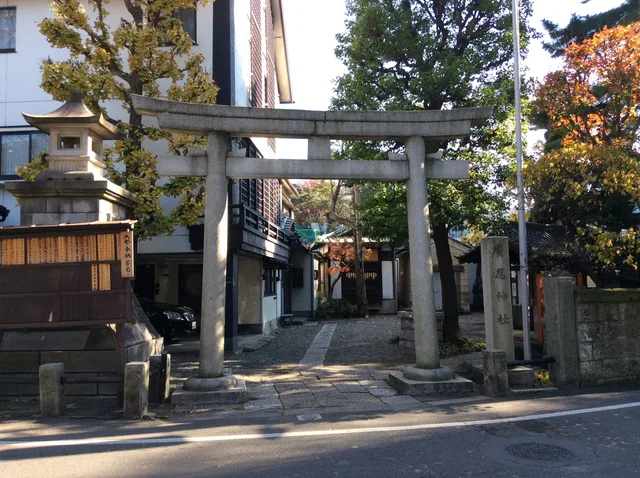
Beyond the stone torii standing by the road, the approach to the grounds continues. At the right is a stone pillar carved "廣尾神社" (Hiroo Shrine), and at the left a large stone lantern, with ginkgo and maple trees all around. You can see how naturally the shrine blends in right beside the buildings ☀️
☀️ Sun-chan's Good Luck Photo Advice
From the entrance of the shrine grounds, try taking a picture that captures the sturdy stone torii gate, the giant joyato (stone lantern), and the modern luxury apartments in the background all together! You'll get an Instagrammable & lucky photo packed tight with the mysterious "contrast power" of history and modernity! ✨
Highlight 2: An Absolute Must-See! The "Magical Ink Dragon" Lurking on the Ceiling of the Worship Hall 🐉✨
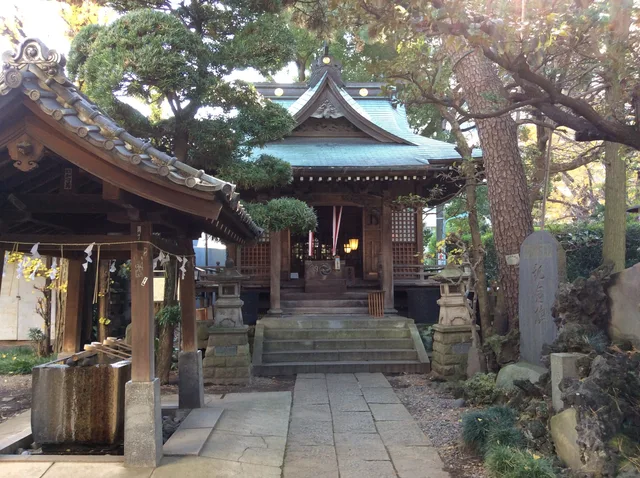
Beyond the approach you can see the worship hall, with the purification fountain at the front left. Big trees surround the blue-green roof, and it's easy to forget you're in the middle of a big city 🌳 Cleanse your hands and mouth at the fountain before praying.
When you visit Hiroo Inari Shrine, one thing you absolutely cannot pass by is the ceiling painting inside the haiden (worship hall)! Take off your shoes, step up into the worship hall (*you can enter by offering a donation/saisen while the shrine office is open between 9 AM and 5 PM), and casually look up at the ceiling... There, glaring down at you, is the overwhelmingly powerful "Bokuryuzu" (Ink Dragon Painting), painted across a massive 350cm x 440cm board!
This dragon was painted by the legendary artist Yuichi Takahashi, who would later be called the "Father of Western Painting in Japan" for his realistic oil paintings like "Salmon." When he painted this in 1847, he was still just 20 years old, leaving behind a signature (rakkan) named "Ransen," showing he had mastered the traditional ink painting techniques of the Kano school.
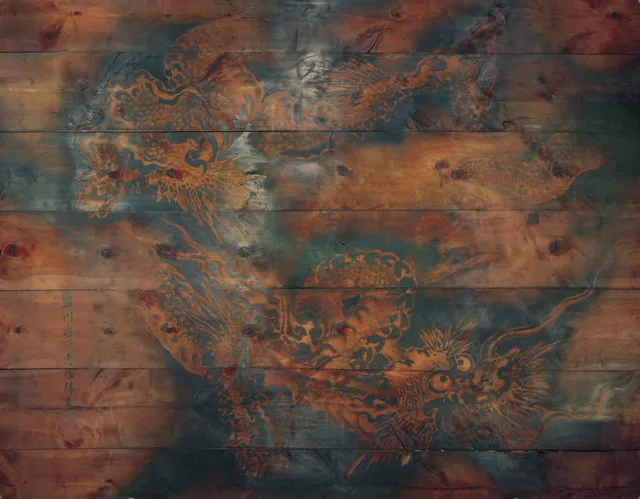
Here is the whole ink dragon painting. Using the wood grain of the boards, the dragon's eyes, scales and coiling body are drawn in shades of ink 🐉 You can also see the artist's signature at the left.
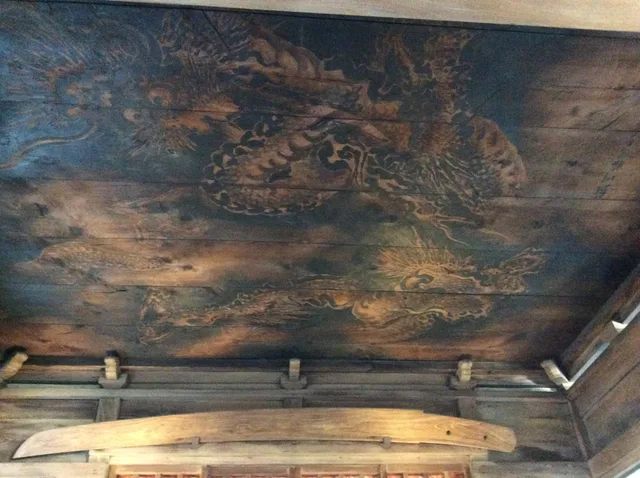
This is the ink dragon painting spreading across the ceiling of the worship hall. The aged color of the boards and the dragon drawn in shades of ink overlap to create a powerful sight 🐉 Go inside and look up, and you can feel its presence up close.
Why Was a Dragon Painted on the Ceiling?
In Eastern lore, dragons possess the power of a water deity who "calls the clouds and makes it rain." Actually, two years before this worship hall was built (in 1845), there was a massive fire called the "Aoyama Fire," and the shrine building completely burned down. The local people and the young Yuichi poured their earnest wishes and prayers—"May this shrine never be engulfed in flames again!"—into this ink dragon, painting it as a guardian to ward off fires.
When you meet the glaring gaze of the dragon drawn with powerful shades of ink, you'll feel a strong warding and fire-preventing (trouble avoidance) power that seems to forcefully drive away the fog in your heart and the seeds of any trouble!
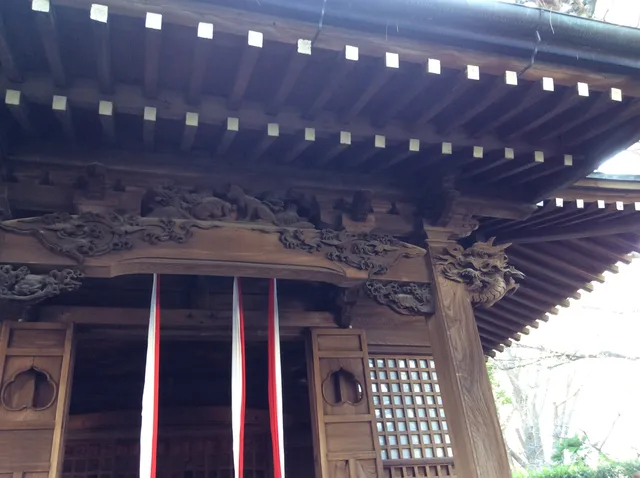
Detailed carvings fill the space under the eaves of the worship hall, and a carved dragon's head can be found atop the pillar on the right 🐉 So there are dragons outside as well as the ink dragon on the ceiling — look up and try to find it.
Highlight 3: Survived Huge Fires and Air Raids! The "Miracle Ginkgo" and its Astonishing Survival Power 🌳✨
The third highlight is the sacred Ginkgo tree, over 400 years old, standing firmly on the shrine grounds! This ginkgo tree was engulfed in the fierce flames of the 1845 Aoyama Fire, and the outside of its trunk became charred black. But you know what? The ginkgo didn't die! It beautifully regenerated while keeping its burnt outer bark, and even today, it grows vibrant, strong green leaves.
What's even more amazing is that the wooden worship hall, rebuilt in 1847, survived the tumultuous disasters and war damages of the 1923 Great Kanto Earthquake and the 1945 Great Tokyo Air Raids completely unscathed, remaining miraculously intact to this day! From this shrine and its sacred tree, which have survived crisis after crisis, flows an overflowing "vitality that won't yield to any adversity" and "strong luck to bounce back from difficulties (survival power)"!
For those thinking "I haven't been lucky lately" or "I absolutely want to succeed in a new challenge!", it will surely give you the strength to never give up and powerful regenerative energy! ☀️
💡 A Little Trivia
Behind the main shrine building, there is a "Koshin-to" (stone monument) made between the Middle Ages and the Edo period, featuring a relief of the famous "See no evil, hear no evil, speak no evil" monkeys. It's a cute spot that helps prevent relationship troubles, so definitely look for it when you visit! 💛
Good Luck Advice from Sun-chan ☀️💛
I'll teach you Sun-chan's style of visiting to charge up 100% of Hiroo Inari Shrine's powerful energy!
- Take a deep breath in front of the torii gate ☀️ As you step from the hustle and bustle of the city into the quiet shrine grounds, take a deep breath and exhale your "daily fatigue and doubts"!
- Give thanks and pray to the main deity 💛 Pray to the main enshrined deity, "Ukanomitama-no-mikoto," expressing your daily gratitude and wishing for business prosperity and daily peace.
- Go up to the worship hall and receive the dragon's spirit 🐉 Get permission at the shrine office, step up to the worship hall, look up at the ink dragon above, and receive the "courage to banish trouble"!
- Charge up vitality from the miracle ginkgo 🌳 Put your hands together towards the sacred tree that continues to live beyond its burn marks, and be granted its never-give-up survival power!
As for good luck crystals, wearing Crystal (Clear Quartz) to ward off evil spirits, or Tiger's Eye to enhance decision-making when visiting is highly recommended, as they easily resonate with the strong energy of the Dragon God and the sacred tree! ✨
Conclusion 🌻
Hiroo Inari Shrine isn't just an "old shrine in a high-end residential area"; it's one of Tokyo's premier hidden power spots, housing "miraculous vitality" that has survived many historical trials and the "prayers of a genius artist"! After enjoying delicious sweets or lunch in the sophisticated town of Hiroo, why not drop by and get the ultimate power charge?
Wishing that your everyday becomes a happy day shining brightly like the sun! ☀️💛 That's all from Sun-chan! See you later~ 🌻✨
🌟 Related Articles You Might Also Like
Tags
この記事をシェアする
この記事が役に立ったら、SNSでシェアしていただけるととても嬉しいです☀️

Thanks so much for reading! I hope this article brought a little sunshine to your day! See you again soon!
Plan Your VisitAd
This section contains affiliate links. See our disclosure.
Plan your trip
Please check the details before booking.
This section contains affiliate links.
You might also like
Omiwa Shrine Worship Guide
This comprehensive guide covers the history, divine blessings, Mount Miwa faith, key worship points, Sai Shrine, the Medicinal Well, sacred mountain ascent (Tohhai), recommended crystals, and surrounding attractions of Omiwa Shrine (1422 Miwa, Sakurai City, Nara Prefecture). It's an essential resource for visiting a sacred site that continues to preserve one of Japan's oldest forms of primitive worship.
[Good Luck × Animism] Drawing Attention Even from Overseas Japan Fans! 5 Carefully Selected 'Bizarre & Cool' Good Luck Shrines in Japan ⛩️✨
A special feature on exquisite good luck spots aimed at overseas readers who love Japan's deep spiritual culture and unique power spots!
Tokyo's Most Powerful Money Luck Shrine: Hebikubo Shrine
Hebikubo Shrine in Shinagawa, Tokyo, is home to a White Snake deity that sheds its skin and is reborn, and a Dragon God that ascends to the heavens. Sun-chan explains its highlights, including the snake-petting stone and the money-washing ritual, and its blessings for wealth and career success.
Seimei Shrine (Seimei Jinja) in Kyoto: Highlights and Blessings
Seimei Shrine in Kyoto enshrines the legendary onmyoji Abe no Seimei and is considered one of Japan's most powerful spots for warding off bad luck. Sun-chan explains its five-pointed star barrier, Seimei Well, and other highlights and blessings.