
Aso Shrine Visitor's Guide
This article contains promotional content.
A comprehensive guide to Aso Shrine (Aso City, Kumamoto Prefecture), covering its history, the deity Takeiwatatsu no Mikoto and the Aso Twelve Gods, its status as one of Japan's Three Great Romon Gates, its restoration after the 2016 Kumamoto Earthquake, the matchmaking Takasago Pine, access information, recommended crystals, nearby attractions, and a frequently asked questions section.
Table of Contents (Tap to toggle)
Introduction
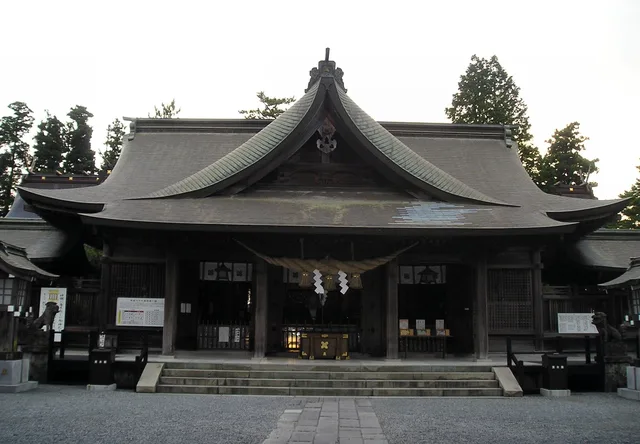
Aso Shrine stands at the foot of Mount Aso, an active volcano with one of the world's largest calderas, and is the Ichinomiya of Higo Province. Its main deity is Takeiwatatsu no Mikoto, a grandson of Emperor Jimmu, along with his family, the Aso Twelve Gods. As the ancestral deities of regional development, they have been revered for over 2,300 years, making this one of Kyushu's most ancient and prominent shrines. The 2016 Kumamoto Earthquake caused the collapse of its Romon Gate and Haiden (worship hall), but the Romon Gate was fully restored in December 2023, once again welcoming worshippers from all over Japan. This article brings together the shrine's history, Romon Gate restoration, the Takasago Pine, FAQ, and an editor's note all on one page.
Table of Contents
- Basic Information and Shrine Data
- History and Origin
- Divine Blessings
- One of Japan's Three Great Romon Gates and Its Restoration from the Earthquake
- The Matchmaking Takasago Pine
- Highlights
- Tips for Visiting
- Access
- Recommended Crystals
- Nearby Spots to Visit
- Recommended Season and Time
- Basic Shrine Etiquette
- Frequently Asked Questions (FAQ)
- Editor's Postscript
- Related Articles You Might Like
Basic Information and Shrine Data
| Item | Content |
|---|---|
| Official Name | Aso Shrine |
| Location | 3083-1 Miyaji, Ichinomiya-machi, Aso City, Kumamoto Prefecture |
| Main Deities | Takeiwatatsu no Mikoto and the Aso Twelve Gods |
| Founding | Tradition states 9th year of Emperor Korei's reign (282 BCE) |
| Shrine Rank | Ichinomiya of Higo Province, formerly Kanpei Taisha (Grand Imperial Shrine) |
| Important Cultural Properties | Romon Gate, Shinden (Main Sanctuary), Haiden (Worship Hall), Gyo-kaeri Mon Gate, and others |
| Official Website | http://asojinja.or.jp |
History and Origin
According to shrine tradition, Aso Shrine was founded in 282 BCE (the 9th year of Emperor Korei's reign). Its history begins with the pioneering myth of Takeiwatatsu no Mikoto, a grandson of Emperor Jimmu, who descended upon Aso and, according to legend, "kicked out the water from the caldera" at the site of Tateno, draining the huge lake that filled the caldera to create arable land. Since then, Aso Shrine, dedicated to Takeiwatatsu no Mikoto and the Aso Twelve Gods of his family, has been revered as the collective guardian deity of the entire Aso region.
From the medieval period onward, the Aso clan successively inherited the position of Daiguji (chief priest), establishing their own power as the Aso Daiguji family during the Sengoku period. The current shrine buildings from the Edo period were rebuilt in the Tenpo era of the 1840s. The Romon Gate was a magnificent architectural work, counted as one of "Japan's Three Great Romon Gates", but it collapsed in the 2016 Kumamoto Earthquake. After seven years of restoration work, it was fully restored in 2023.
Source: Aso Shrine official documents, various historical materials of the Kumamoto region.
Divine Blessings
- Matchmaking and Marital Harmony (Legend of the Takasago Pine)
- Family Safety and Protection from Evil
- Abundant Harvests and Agricultural Prosperity (Takeiwatatsu no Mikoto's pioneering myth)
- Good Fortune and Prosperity
- Disaster Recovery and Regeneration (History of earthquake recovery)
One of Japan's Three Great Romon Gates and Its Restoration from the Earthquake
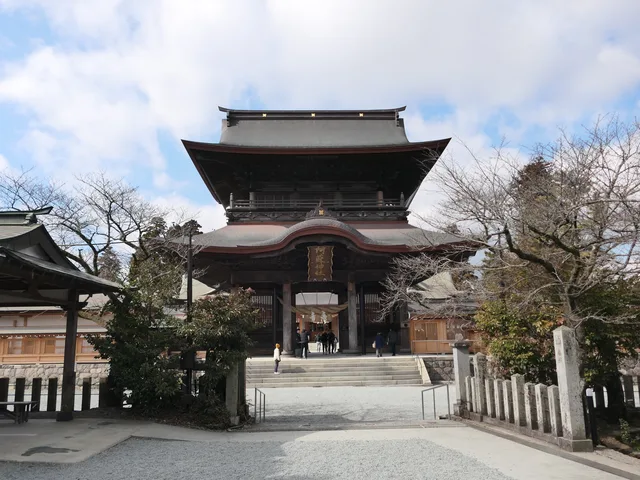
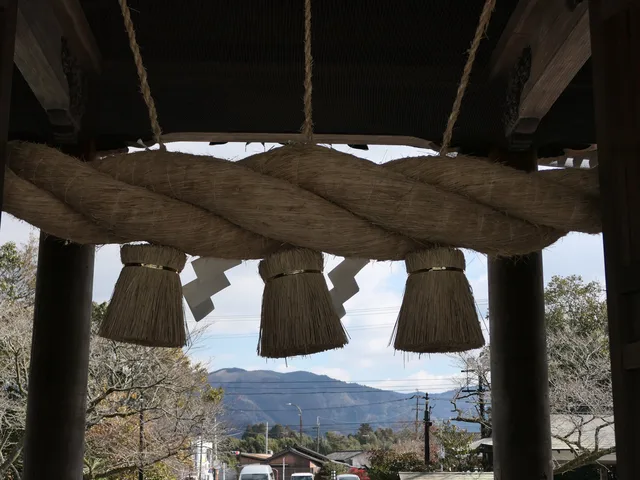
Aso Shrine's Romon Gate is one of "Japan's Three Great Romon Gates," alongside those of Iwashimizu Hachimangu Shrine in Kyoto and Hakozakigu Shrine in Fukuoka. This magnificent two-storied gate, standing approximately 21 meters tall, was built in 1849 and is designated as an Important Cultural Property of Japan.
In April 2016, the Kumamoto Earthquake caused devastating damage, leading to the collapse of the Romon Gate, Haiden, and parts of the Shinden (main sanctuary). After seven years of extensive restoration work, the Romon Gate was fully restored in December 2023, returning almost to its original appearance from the time of its construction. It garnered national attention as a symbolic example of cultural property restoration, with approximately 12,000 salvaged parts meticulously repaired one by one.
The Matchmaking Takasago Pine
The "Takasago Pine" within the grounds of Aso Shrine has long been revered as a sacred tree for matchmaking and fostering love. The tradition states that men walk around the pine from the left side, and women from the right, while making a wish, to be blessed with a good partner. This practice is still observed by many visitors, especially younger ones.
Furthermore, it is believed that if you gently stroke the "Gankake-ishi" (Wish-granting Stone) within the shrine grounds while making a wish, your wish will come true. This makes Aso Shrine a cherished place for both matchmaking and the fulfillment of heartfelt desires.
Highlights
- Romon Gate (One of Japan's Three Great Romon Gates, restored in 2023)
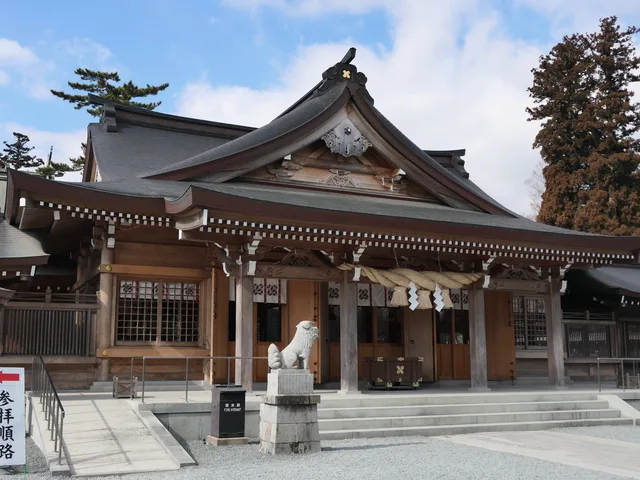
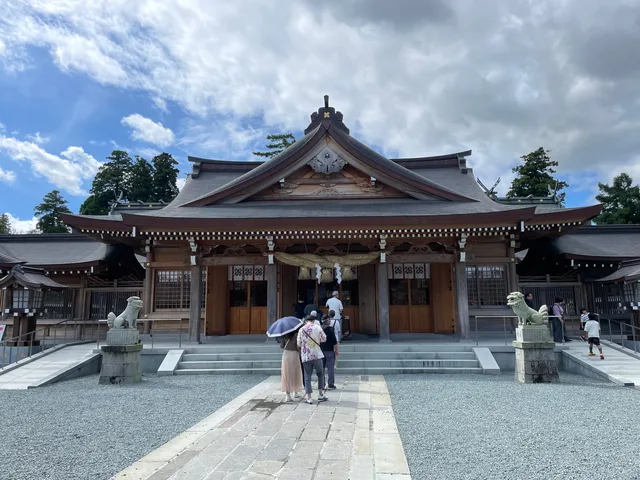
- Main Hall and Shinden (Main Sanctuary) (Important Cultural Properties)
- Takasago Pine (Sacred tree for matchmaking)
- Gankake-ishi (Wish-granting Stone)
- Kami no Izumi (Sacred Spring) (Spring water within the grounds)
- Monzenmachi Shopping Street (Enjoy local snacks and souvenirs)
Tips for Visiting
- Walking around the Takasago Pine from the direction corresponding to your gender is said to bring good relationships.
- Learning about the history of the Romon Gate's restoration can make your visit even more poignant.
- Touch the spring water at Kami no Izumi (Sacred Spring) within the grounds.
- Combine your visit with a trip to Mount Aso's crater for a full-day itinerary.
- Exploring the springs in the Monzenmachi area is also a popular activity.
Access
By Train: Approximately a 15-minute walk from JR Hohi Main Line "Miyaji Station."
By Car: Approximately 1 hour from Kumamoto IC on the Kyushu Expressway, or approximately 50 minutes from Mashiki Kumamoto Airport IC.
Parking: Free dedicated shrine parking available (approx. 40 spaces). During crowded times, paid parking in the Monzenmachi area is also available.
Recommended Crystals
Here are some stones believed to resonate well with the sacred energy of Aso Shrine, which you might consider bringing along for your visit.
| Stone | Reason for Compatibility |
|---|---|
| Garnet | Passion and regenerative energy of the volcano |
| Rose Quartz | For matchmaking and prayers at the Takasago Pine |
| Spinel | Vitality and resurrection, resonates with earthquake recovery |
| Clear Quartz | Amplifies the purifying energy of the Kami no Izumi (Sacred Spring) |
Nearby Spots to Visit
- Mount Aso Crater (Nakadake) — Witness the active volcano's crater
- Kusasenrigahama — A representative grassland landscape of Aso
- Kamishikimi Kumanoza Shrine — A mysterious shrine known for its sun-dappled approach path
- Daikanbo — An observatory offering panoramic views of the Aso Caldera
Recommended Season and Time
The shrine is open for visits year-round. Spring after the controlled burns (April-May) when new green shoots emerge, summer with blooming gentians in the grasslands (July-August), and autumn foliage (October-November) are particularly beautiful times. Please check in advance for any restrictions on entering the Nakadake crater due to volcanic gas warnings.
Basic Shrine Etiquette
- Bow before passing through the Torii gate and Romon Gate.
- The center of the Sando (main approach path) is for the deities; please walk along the sides.
- At the Temizuya (water purification pavilion), cleanse your left hand, then right hand, rinse your mouth, cleanse your left hand again, and finally clean the ladle.
- Perform "Nihai Nihakushu Ippai" (two bows, two claps, one bow).
- When circling the Takasago Pine, please be considerate and do not obstruct other worshippers.
- Do not enter areas where restoration work is still underway.
If you are unsure about basic worship etiquette, please also refer to the Complete Guide to Basic Shrine Visiting Etiquette.
Frequently Asked Questions (FAQ)
Q1. Has the restoration from the earthquake been completed?
A. The Romon Gate was fully restored in December 2023, and major construction on the main buildings is largely complete. Some minor detail work may still be ongoing, so please check the official website for the latest information.
Q2. How do I circle the Takasago Pine?
A. Traditionally, men circle the pine from the left, and women from the right, while silently making a wish. There may be a queue, so please be courteous and yield to other worshippers.
Q3. Can I visit the Mount Aso crater?
A. Access to the Nakadake crater is subject to change based on volcanic gas concentration and crater activity. Please check the Aso Volcano Disaster Prevention Council's website for the latest conditions on the day of your visit. It is recommended that individuals with respiratory conditions refrain from visiting even if regulations are lifted.
Q4. Where can I get a Goshuin (shrine stamp)?
A. You can receive a Goshuin at the Juyosho (shrine office / reception for amulets, etc.) located to the right after entering the Romon Gate. Limited edition Goshuin may be available during certain periods to commemorate the restoration, so please inquire during your visit.
Q5. Is the water from Kami no Izumi (Sacred Spring) potable?
A. The Kami no Izumi (Sacred Spring) that wells up on the shrine grounds has long been considered sacred water. However, for official information regarding its potability and water quality testing, it's best to confirm directly with the shrine office. Traditionally, it is used for purifying hands and face.
Editor's Postscript
What truly stands out about Aso Shrine is the profound emotion one feels upon standing before the restored Romon Gate. For those of us who remember the news of its collapse, the very fact that "the Romon Gate stands here once again" feels like a blessing in itself. A shrine that has watched over the people at the foot of a volcano for over a thousand years has been resurrected even after an earthquake — there aren't many shrines where the word "regeneration" resonates with such tangible reality.
Related Articles You Might Like
- Complete Guide to Basic Shrine Visiting Etiquette — Etiquette, manners, and how to make wishes
- Kirishima Jingu Shrine Visitor's Guide — Kyushu's Sacred Site of Mythology
- Garnet Meaning and Effects — The Stone of Passion and Regeneration
- Rose Quartz Meaning and Effects — An Amulet for Love and Relationships
Summary
- Aso Shrine is the Ichinomiya of Higo Province, a leading ancient shrine located at the foot of Mount Aso in Kyushu.
- Its main deities are Takeiwatatsu no Mikoto and the Aso Twelve Gods, ancestral deities of Aso's development.
- The Romon Gate is one of Japan's Three Great Romon Gates, fully restored in 2023 after the earthquake.
- Prayers for matchmaking can be made by circling the Takasago Pine.
- It is a sacred place of volcanoes that you should visit in conjunction with Mount Aso's crater and Kusasenri.
Whether you're looking to find love or seeking the power of regeneration, the resurrected Romon Gate and the life force of the volcano at Aso Shrine will surely give you a strong push towards a new beginning!
Tags
この記事をシェアする
この記事が役に立ったら、SNSでシェアしていただけるととても嬉しいです☀️

Thanks so much for reading! I hope this article brought a little sunshine to your day! See you again soon!
Plan Your VisitAd
This section contains affiliate links. See our disclosure.
Plan your trip
Please check the details before booking.
This section contains affiliate links.
You might also like
Omiwa Shrine Worship Guide
This comprehensive guide covers the history, divine blessings, Mount Miwa faith, key worship points, Sai Shrine, the Medicinal Well, sacred mountain ascent (Tohhai), recommended crystals, and surrounding attractions of Omiwa Shrine (1422 Miwa, Sakurai City, Nara Prefecture). It's an essential resource for visiting a sacred site that continues to preserve one of Japan's oldest forms of primitive worship.

Enoshima Shrine Visit Guide
A comprehensive guide to Enoshima Shrine (Enoshima Island, Fujisawa City, Kanagawa Prefecture), covering its history, the Munakata Three Goddesses (Tagorihime-no-Mikoto, Ichikishimahime-no-Mikoto, Tagitsuhime-no-Mikoto), Hetsunomiya, Nakatsunomiya, Okutsunomiya, Japan's Three Great Benzaiten, key visiting points, access, recommended crystals, nearby attractions, and FAQs.

Fujisan Hongu Sengen Taisha Shrine Pilgrimage Guide
A comprehensive guide to Fujisan Hongu Sengen Taisha Shrine (1-1 Miyamae-cho, Fujinomiya City, Shizuoka Prefecture), covering its history, benefits, the legend of Konohanasakuyahime no Mikoto, Wakutama Pond, the Okumiya (Inner Shrine) at the summit, key points for worship, recommended crystals, and nearby attractions. This is your essential resource for visiting the heart of Mount Fuji's World Heritage worship.
Kirishima Jingu Pilgrimage Guide
A comprehensive guide to Kirishima Jingu (Kirishima City, Kagoshima Prefecture), covering its history, Ninigi-no-Mikoto, the Tenson Korin myth, the vermilion National Treasure shrine, Sakamoto Ryoma's honeymoon, Mt. Takachiho trailhead, key visiting points, access, recommended crystals, nearby attractions, and FAQs.