
Pilgrimage and Good Luck: Exploring the Sites Connected to Your Name.
This article contains promotional content.
Lake Suwa, Suwa Taisha Shrine, and Hida-Furukawa are said to be among the inspirations behind Your Name. Sun-chan explains the view at Kataware-doki, the teaching of Musubi, the kumihimo braiding craft, and the good luck rooted in these sacred sites.
Table of Contents (Tap to toggle)
Hello! It's Sun-chan from Lucky Sun Shine! ☀️
Your Name. (Kimi no Na wa.), the animated film by director Makoto Shinkai, swept the entire world up in a wave of emotion. Many of you were probably deeply moved by its beautiful visuals and the bond between two people drawn to each other across time and space, weren't you?
Actually, if you trace the source of inspiration behind "Itomori," the fictional town where the heroine Mitsuha lived, you arrive at real sacred sites that go far beyond the romance of the film itself: places where some of Japan's oldest mountain worship, a crossing point of myth and the cosmos, and the spiritual power of "Musubi" (the bond that connects people) still live on today!
This time, I'm introducing two great sacred sites: Lake Suwa and Suwa Taisha Shrine (Suwa-taisha) in Nagano Prefecture, said to be among the inspirations for Itomori Lake's breathtaking panorama, and Hida-Furukawa in Gifu Prefecture, said to be among the inspirations for the town's streets and traditional crafts.
Sun-chan will cheerfully and clearly tell you why these particular places were so fitting, and what wonderful good-luck energy we can receive by visiting them! ☀️
🌊 [Suwa, Nagano] The Breathtaking View at "Kataware-doki" and Ancient Nature Worship! A Primal Sacred Realm With No Main Hall
Itomori Lake, the beautiful caldera lake that's a symbol of the film, has as one of its visual inspirations Lake Suwa, the largest lake in Nagano Prefecture, cradled by the mountains of Yatsugatake and Kirigamine. The Suwa region is a special power spot where one of Japan's oldest faiths—worshipping the earth itself as divine—still lives on today.
Tateishi Park and "Kataware-doki"
- 【Features】: A park with a breathtaking view, located on a hillside on the eastern side of Lake Suwa. At dusk, the circular panorama of Lake Suwa spreading out below blends with the sky, creating a breathtaking gradient of color.
- 【Deep Background and Origins】: "Kataware-doki," depicted in the film as the boundary between day and night, comes from the old Japanese word "tasokare-doki" (literally, "who is that, over there?"—meaning twilight). Back when there were no streetlights, the dim hours of dusk, when it became hard to make out people's faces, were both feared and revered as "ōmagatoki" (the hour when demons appear)—a time when the boundary between this world and the otherworld (the realm of gods and spirits) grew blurry, and miracles or encounters with the supernatural could occur. When you watch the sun set over Lake Suwa, you can directly relive the "awe of and prayer toward nature" that ancient people once felt.
- 【Sun-chan's Top Pick Explanation】: The view from Tateishi Park at dusk truly looks just like a scene from the movie! As you gaze at the sky shifting from orange to indigo, your everyday worries and distractions melt away, and a natural feeling of gratitude toward the people who matter to you wells up. This is the twilight spot Sun-chan most recommends for anyone wanting to reset their heart during a turning point in life ☀️
- 【Official Info】: Suwa Tourism Association Official Website (Tateishi Park)
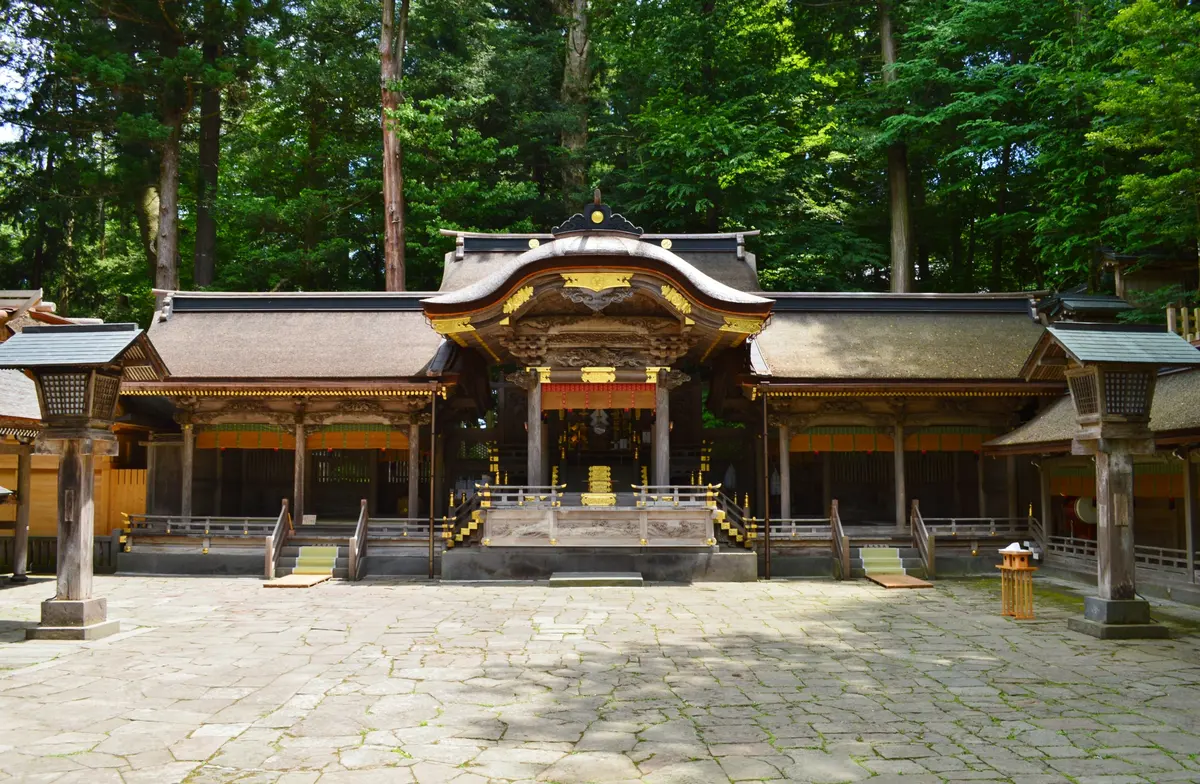
Suwa Taisha Shrine (Suwa-taisha), the First Shrine of Shinano Province
- 【Features】: Suwa Taisha is the head shrine of over 10,000 Suwa shrines nationwide, made up of two shrine complexes and four sanctuaries: the "Upper Shrine" (Honmiya and Maemiya) to the south of Lake Suwa, and the "Lower Shrine" (Harumiya and Akimiya) to the north.
- 【Deep Background and Origins】: This is one of Japan's oldest shrines, but its biggest distinguishing feature is that none of its three main sanctuaries—Kamisha Honmiya, Shimosha Harumiya, and Shimosha Akimiya—has a honden (the building that normally houses the deity). Rather than worshipping at a man-made shrine building, visitors worship directly at Mt. Moriya, the sacred mountain itself, or at the giant sacred trees within the grounds, carrying on a form of primal nature worship (animism) that has continued since the Jomon period.
- 【Sun-chan's Top Pick Explanation】: This is the pure power of Shinto in its original form: feeling that the deities dwell not in buildings, but in the mountains, the wind, and the great trees themselves! Each of the four sanctuaries has its own distinct character and refreshing energy, so if you take your time visiting all four in the "Shisha-meguri" pilgrimage, the earth's energy will fill your whole body, granting you powerful grounding (establishing your own sense of self) ☀️
- 【Official Info】: Suwa Taisha Shrine Official Website
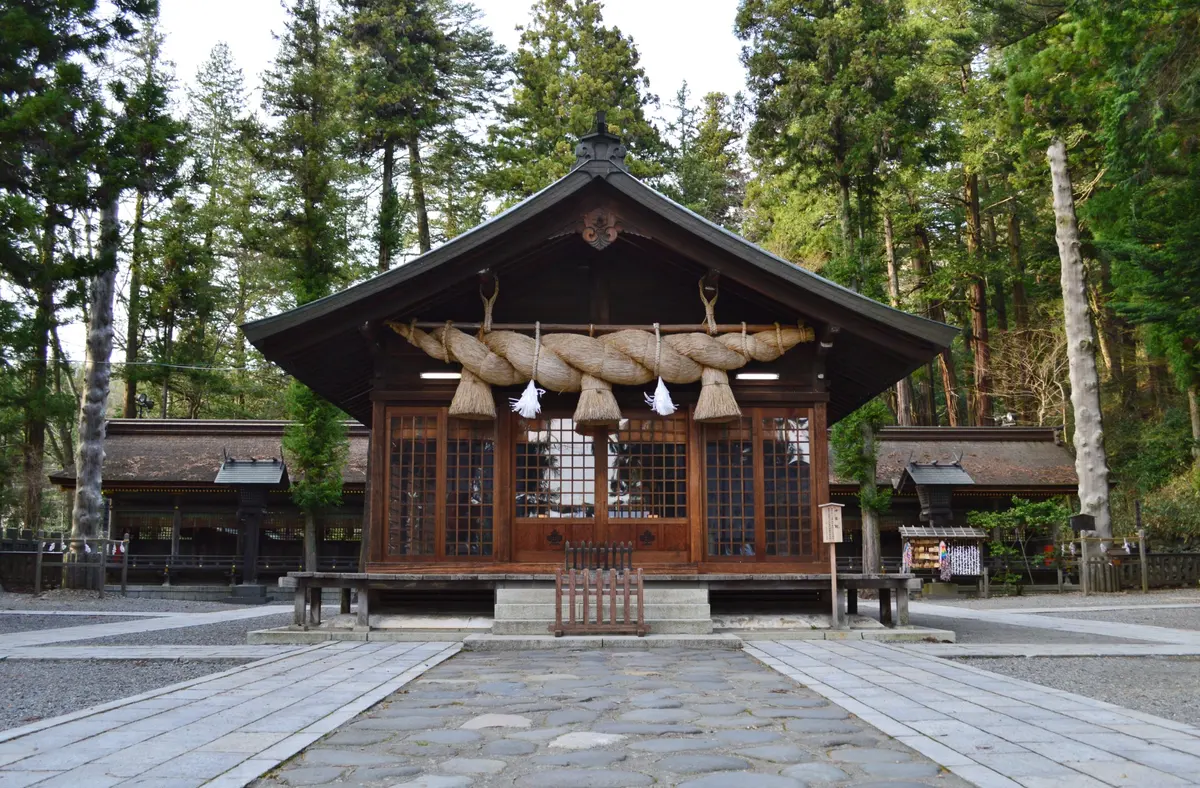
The Onbashira Festival and the Barrier at the Four Corners
- 【Features】: One of Japan's three great unusual festivals, held once every six years, in the years of the Tiger and the Monkey. Sixteen giant fir logs, over 150 years old and cut from the mountains, are hauled entirely by human power and erected at the four corners of each shrine's grounds.
- 【Deep Background and Origins】: Its official name is "Shikinen Zōei Onbashira Taisai." The dramatic "Kiotoshi" (log-sliding) ceremony, where logs are sent sliding down the mountainside, is famous, but the true purpose is to "re-establish the sacred barrier of the shrine grounds by erecting giant logs at the four corners." The moment the logs are carved and a giant "Taigohei" (sacred wand) is driven into them, plain timber is transformed into a "living deity" (a sacred tree). The sight of the whole town coming together to ward off misfortune and carry life and prosperity into the future closely mirrors the bond among the townspeople who tried to save their town in the film.
- 【Sun-chan's Top Pick Explanation】: Standing in front of the imposing Onbashira pillars at the four corners of the shrine grounds, you'll feel wrapped in a sense of security, as if protected by an invisible barrier of light! It will grant wonderful power to anyone who wants to ward off misfortune and protect themselves with unshakeable energy ☀️
- 【Official Info】: Suwa Taisha Onbashira Festival Official Website
Lake Suwa's "Omiwatari," and the Ancient Custom Behind the Film's Kuchikami-zake
- 【Features】: A mysterious natural phenomenon that occurs when Lake Suwa freezes over completely in the depths of winter: the ice expands and rises up in a straight line, like a mountain range.
- 【Deep Background and Origins】: According to Suwa legend, Omiwatari has long been believed to be the trail of footsteps left by the love between the male deity of the Upper Shrine (Takeminakata-no-kami) as he crossed to visit the female deity of the Lower Shrine (Yasakatome-no-kami). Separately, "kuchikami-zake" (mouth-chewed sake), the sacred brew that Mitsuha and the other shrine maidens carry on in the film, isn't a ritual tied to any specific shrine—it's based on an ancient Japanese brewing method recorded in fragments of the Fudoki of Osumi Province, among other sources. In this ancient custom, rice was chewed in the mouth, using enzymes in saliva to promote fermentation, and it has been passed down as a form of prayer offering human vitality and breath to the gods.
- 【Sun-chan's Top Pick Explanation】: The idea of deities crossing a path of ice to meet their beloved is the height of romance, isn't it! Witnessing this mysterious cycle woven by nature naturally warms the heart of anyone who sees it ☀️
- 【Reference Info】: Shimosuwa Onsen Tourism Association (Omiwatari Explanation)
🧵 [Hida-Furukawa, Gifu] The Power of Kumihimo (Musubi) That Connects People and Time, and the White-Walled Storehouse District
If Suwa carries the grand "soul of nature and the cosmos," then Hida-Furukawa in Hida City, Gifu Prefecture, is said to be among the inspirations for the everyday scenery where Mitsuha and the others live—the somehow-nostalgic train station and library—as well as for the traditional craft at the heart of the story.
The Traditional Craft of Kumihimo (Braided Cord) and the Teaching of Musubi
- 【Features】: A traditional Japanese craft in which vividly colored silk threads are crossed diagonally using wooden tools like a maru-dai (round braiding stand), woven into beautiful obi cords and braids.
- 【Deep Background and Origins】: In the film, Mitsuha's grandmother says, "Connecting thread is Musubi. Connecting people is Musubi. The flow of time is also Musubi." In Shinto, "Musuhi" refers to the fundamental creative power of the cosmos that gives birth to, nurtures, and connects all things in heaven and earth. Kumihimo—twisted together into shape, twisting, tangling, and sometimes breaking only to be reconnected—symbolizes life itself, and the fated encounters we have with other people (the red thread of destiny).
- 【Sun-chan's Top Pick Explanation】: At the "Hida Furukawa Sakura Souvenir Hall" in Hida-Furukawa, you can actually choose your own threads and braid kumihimo with your own hands! The time spent focusing on crossing the threads is truly a meditation that aligns your heart and your destiny. The finished kumihimo makes the best charm for drawing in wonderful connections ☀️
- 【Experience Info】: Hida City Tourism Association Official Website (Hida Furukawa Sakura Souvenir Hall)
The Seto River and the White-Walled Storehouse District (Shirakabe Dozo-gai)
- 【Features】: A charming, nostalgic walking spot where the clear waters of the Seto River flow alongside white-walled storehouses and temple stone walls that still carry the atmosphere of the Edo period.
- 【Deep Background and Origins】: Over 1,000 vividly colored koi carp swim in the Seto River, maintained as a source of local pride and as a way of preserving the town's water quality. To help the koi survive Hida's deep snowy winters, every year in late November, local residents carry them by hand to warm wintering ponds, then return them to the river each spring (in early April)—a tradition known as the "koi's moving day." The warm community power of the townspeople, who live in harmony with nature and pass down this scenery across generations, is itself what keeps the land's energy pure.
- 【Sun-chan's Top Pick Explanation】: Just strolling leisurely along the river, feeding the koi some fu (wheat gluten) at the feeding spots, will gently untangle your everyday stress and prickly feelings! The babbling of the river and the quiet of the white walls will softly purify the aura of anyone who visits ☀️ (Note: the koi are away at their wintering ponds during the winter months, but the silver snow scenery is breathtakingly beautiful in its own right.)
- 【Official Info】: Hida City Tourism Association Official Website (Seto River and the White-Walled Storehouse District)
Keta Wakamiya Shrine
- 【Features】: Located about a 15-minute walk from Hida-Furukawa Station, this shrine sits in a quiet forest surrounded by giant cedar trees, marked by a long, straight stone staircase and a striking vermilion torii gate.
- 【Deep Background and Origins】: This sacred site is said to be the model for a shrine that appears in the film. Its annual festival, the "Furukawa Matsuri," held every April 19th and 20th, is registered as a UNESCO Intangible Cultural Heritage, and the excitement of the "Okoshi-daiko" (wake-up drum), in which men carry giant drums through town at night, is an overwhelming sight. The shrine serves as Hida's spiritual pillar, where quiet prayer and a once-a-year explosion of passionate vitality exist side by side.
- 【Sun-chan's Top Pick Explanation】: With every step you take climbing the stone staircase, you'll feel the noise of the secular world growing more distant, replaced by a sacred stillness! This is a place that offers clear inspiration whenever you want to quietly face yourself, or ask your heart "what really matters to me" ☀️
- 【Official Info】: Hida City Tourism Association Official Website (Keta Wakamiya Shrine)
☀️ In Closing
The reason Your Name. continues to capture the hearts of people all over the world is that it beautifully and carefully weaves in the soul of Japan: "the bond that connects people," and "a reverence for nature that has continued since ancient times."
Being held by the grand nature of Lake Suwa awakens the primal senses within us, and re-spinning the threads of "Musubi" amid the warm daily life of the town of Hida-Furukawa becomes something more than simply retracing an anime's footsteps—it becomes a journey of the soul's renewal, where you remember precious memories and connections you'd nearly forgotten.
If you've been feeling that "my connections with other people feel thin lately..." or thinking "I want an encounter that will dramatically change my fate!", please visit these sacred sites living on in the mountains of Nagano and Gifu. The warm light spun together across time and space is sure to gently wrap around your life!
Wishing that your every day is tied together with many warm, good connections! That's all from Sun-chan at Lucky Sun Shine! ☀️
🌟 Related Articles You Might Also Like
- Pilgrimage and Good Luck: Exploring the Sites Connected to Demon Slayer! The Truth Behind "Sealing the Demon Gate and Warding Off Evil" at Kamado Shrine in Dazaifu and Senso-ji Temple
- Suwa Taisha Shrine Visiting Guide: The First Shrine of Shinano Province, Known for Its Four-Shrine Pilgrimage and Onbashira Festival Held Once Every Seven Years
- A Complete Guide to Shrines for Matchmaking and Romance: Blessings, Visiting Tips, and Famous Shrines Nationwide
- A Complete Guide to Chubu Region Power Spot Shrines: Blessings, Access, and Model Courses
Tags
この記事をシェアする
この記事が役に立ったら、SNSでシェアしていただけるととても嬉しいです☀️

Thanks so much for reading! I hope this article brought a little sunshine to your day! See you again soon!
Plan Your VisitAd
This section contains affiliate links. See our disclosure.
Plan your trip
Please check the details before booking.
This section contains affiliate links.
You might also like
Pilgrimage and Good Luck
Kamado Shrine in Dazaifu and Senso-ji Temple in Tokyo are both known as pilgrimage sites for Demon Slayer fans. Sun-chan explains the good luck origins behind these two sacred sites, from sealing the demon gate and matchmaking to the guardian Wind and Thunder Gods.

Omiwa Shrine Worship Guide
This comprehensive guide covers the history, divine blessings, Mount Miwa faith, key worship points, Sai Shrine, the Medicinal Well, sacred mountain ascent (Tohhai), recommended crystals, and surrounding attractions of Omiwa Shrine (1422 Miwa, Sakurai City, Nara Prefecture). It's an essential resource for visiting a sacred site that continues to preserve one of Japan's oldest forms of primitive worship.

Pilgrimage and Good Luck
Nikko Toshogu Shrine echoes the Chinese zodiac myth at the heart of Fruits Basket. Sun-chan explains the healing power found in the story of the Sleeping Cat and the eight life-stage carvings of the Three Wise Monkeys at the Sacred Stable.
Pilgrimage and Good Luck: Tracing the Sites Connected to Inuyasha
The Shikon Jewel and the priestess's warding arrows in Inuyasha echo Fushimi Inari's sacred jewel and Shinto's view of the soul, Ichirei Shikon. Sun-chan explains the good-luck hints found in these legends, together with Kuzunoha Inari and Hozan-ji.